Manufacturing SEO: Tips & Strategies to Generate More Leads

Ashot Nanayan
SEO Strategist
Table of content
I spent more than thirty minutes quickly flying through the top “Manufacturing SEO” guides, only to realize that most so-called playbooks are the same general SEO checklists with some manufacturing keyword placements.
No, guys, manufacturing companies deserve specific advice from hands-on experience. They have no time to read recycled articles written by people who have no clue about SEO or manufacturing in general. I think it’s not fair at all.
Yeah, that’s my main motivation today, and I accept the challenge. In this guide, I’m going to discuss the main principles of manufacturing SEO, list out proven strategies that work for our manufacturing SEO agency, and even share some advice that your competitors would dream of.
If you’re looking for modern solutions, hands-on experience, and something new, keep reading.
Ready to grow smarter?
Book a free 30-minute strategy call with our team. We'll audit your search visibility and build a custom action plan.
What Is Manufacturing SEO?
Manufacturing SEO is the process of making your manufacturing company easier to find on Google, Bing, and LLMs when potential buyers, distributors, engineers, procurement managers, or other decision-makers search for the products, services, materials, or solutions you offer.
In simple words, it’s about helping the right people find your company before they find your competitors.
The main idea is not very different from regular SEO. You still need a clean website, a strong technical SEO setup, good content, the right keywords, useful pages, backlinks, and a clear structure.
However, manufacturing SEO has its own details, and that’s what we’re going to discuss in this article.
What Types of Keywords Are Important for Manufacturing SEO?
In my opinion, everything depends on your B2B SEO strategy, current SEO stage, goals, budget, and several other factors.
To make it clear, if you’re a newly launched website with a limited SEO budget, you might consider targeting keywords with high lead potential but small search volume and lower competition.
On the other hand, if you have an established company with strong authority, you can also focus on high-KD keywords with strong commercial intent.
When I say “important,” I don’t just mean having dedicated pages for each keyword. I also mean how you prioritize those keywords and pages by building topical authority around them, linking with relevant anchors, supporting them with related content, and so on.
Below, I also created a simple table where you’ll see some types of keywords that are important for manufacturing firms.
Manufacturing Keyword Types
Manufacturing SEO works best when you target more than broad product terms.
| Keyword Type | Examples |
|---|---|
| Product keywords | CNC machined parts, custom metal components, industrial valves, plastic injection molded parts |
| Service keywords | contract manufacturing services, precision machining services, sheet metal fabrication services |
| Industry keywords | aerospace component manufacturing, medical device manufacturing, automotive parts manufacturing |
| Material-based keywords | stainless steel fabrication, aluminum CNC machining, silicone molding, carbon steel components |
| Application Keywords | parts for hydraulic systems, components for packaging machines, custom parts for robotics |
| Problem-Based Keywords | reduce production downtime, improve part durability, replace worn machine components |
| Specification keywords | ISO certified manufacturer, tight tolerance machining, high-volume production, low-volume prototyping |
| Location keywords | manufacturing company in Texas, CNC machining in California, metal fabrication near Chicago |
| Comparison keywords | CNC machining vs injection molding, aluminum vs stainless steel parts, prototype vs production tooling |
| Supplier Keywords | industrial parts supplier, OEM component supplier, private label manufacturer, contract manufacturer |
What Pages Should a Manufacturing Website Have for SEO?
I know that most manufacturing websites have bad UX, abandoned blog content, and pages that exist just because nobody had time to properly work on them.
However, if you’re trying to build the right foundation by redesigning your current website or designing a new site from scratch, here are the top web pages you should take into account for better SEO and user experience:
Essential SEO Pages for Manufacturing Websites
For SEO, the site needs pages that match how buyers search: by product, service, material, industry, location, technical capability, and supplier requirements.
| Page Type | Why It Is Important |
|---|---|
| Homepage | Clearly explains what the company manufactures, who it serves, where it operates, and why buyers should trust it. |
| Core Service Pages | Targets searches like CNC machining services, sheet metal fabrication, contract manufacturing, assembly, or prototyping. |
| Product / Component Pages | Helps rank for specific parts, components, equipment, materials, or manufactured products buyers are actively searching for. |
| Industry Pages | Targets buyers in sectors like aerospace, automotive, medical devices, construction, electronics, oil and gas, or packaging. |
| Location Pages | Supports local and regional SEO for searches like “manufacturer in Texas” or “CNC machining company near Chicago.” |
| Blog / Resource Hub | Targets educational searches, comparison keywords, cost questions, material guides, design tips, and problem-based queries. |
| About Us Page | Builds company credibility by explaining history, facility size, equipment, team experience, and manufacturing expertise. |
| Case Study / Project Pages | Builds trust and gives Google stronger proof of real manufacturing experience, industries served, and project outcomes. |
| Contact / RFQ Page | Helps convert SEO traffic into leads with clear quote forms, technical upload options, phone numbers, and sales contact details. |
Content Ideas for Manufacturing SEO
Today’s content strategies don’t look like what worked three or five years ago.
Gone are the days when you could generate thousands of visits with topics like “Types of Manufacturing Processes” or “What Is Contract Manufacturing.”
AI Overviews now steal a lot of potential traffic. I’m not even talking about the fact that you should also align your content with LLM intent by making sure you cover unique BOFU and MOFU topic ideas.
Below, I prepared another table where you’ll see the top content ideas you should consider with the highest potential to generate leads through SEO.
Content Ideas for Manufacturing SEO
The best ideas usually come from buyer questions around materials, tolerances, costs, production methods, lead times, quality standards, and industry use cases.
| Content Idea | Why It Works for SEO |
|---|---|
| Material comparison guides | Targets searches like aluminum vs stainless steel, plastic vs metal parts, or silicone vs rubber components. |
| Manufacturing process explainers | Helps rank for searches around CNC machining, injection molding, die casting, laser cutting, fabrication, assembly, and finishing. |
| Cost breakdown articles | Captures high-intent searches from buyers comparing production costs, tooling costs, prototype costs, or bulk order pricing. |
| Industry-specific guides | Targets niche buyers in aerospace, automotive, medical devices, electronics, construction, energy, packaging, and agriculture. |
| Tolerance and specification content | Attracts technical buyers searching for tight tolerance, ISO standards, quality control, material grades, and inspection processes. |
| Problem-solving content | Targets searches around reducing defects, improving durability, lowering production delays, or choosing the right manufacturing method. |
| Comparison articles | Helps buyers compare CNC machining vs injection molding, prototyping vs production tooling, or domestic vs overseas manufacturing. |
| FAQ-style buyer content | Answers common questions about lead times, minimum order quantity, RFQs, shipping, custom orders, certifications, and quality checks. |
Top Manufacturing SEO Tips & Strategies From an Agency Owner
I’ve covered many guides, from oil & gas SEO and construction SEO to accounting SEO and dozens of others, and believe me, none of them are the same.
Of course, I tried to keep the main principles everywhere to avoid confusion, but the tips and strategies are always unique and aligned with each specific industry’s needs.
Manufacturing SEO is not an exception either. Below, you’ll find seven specific tips and strategies based on our B2B SEO agency’s experience from the last couple of years.
Build Separate Pages for Each Manufacturing Capability
I think SEO is very simple if you don’t overcomplicate it. The most important thing to understand is what your audience is looking for. Let’s bet that most of your competitors only have a homepage or one service page with the main target keyword.
I’m not reinventing the wheel here, but this is one of the biggest SEO mistakes.
Instead of having one “Services” page, create dedicated pages for CNC machining, metal fabrication, injection molding, welding, laser cutting, assembly, prototyping, finishing, and so on.
The good thing is that you can also create dedicated sub-pages for some of the main services.
For example, if we’re talking about “injection molding,” you have dozens of other opportunities, such as “plastic injection molding services” or “HDPE injection molding services.”
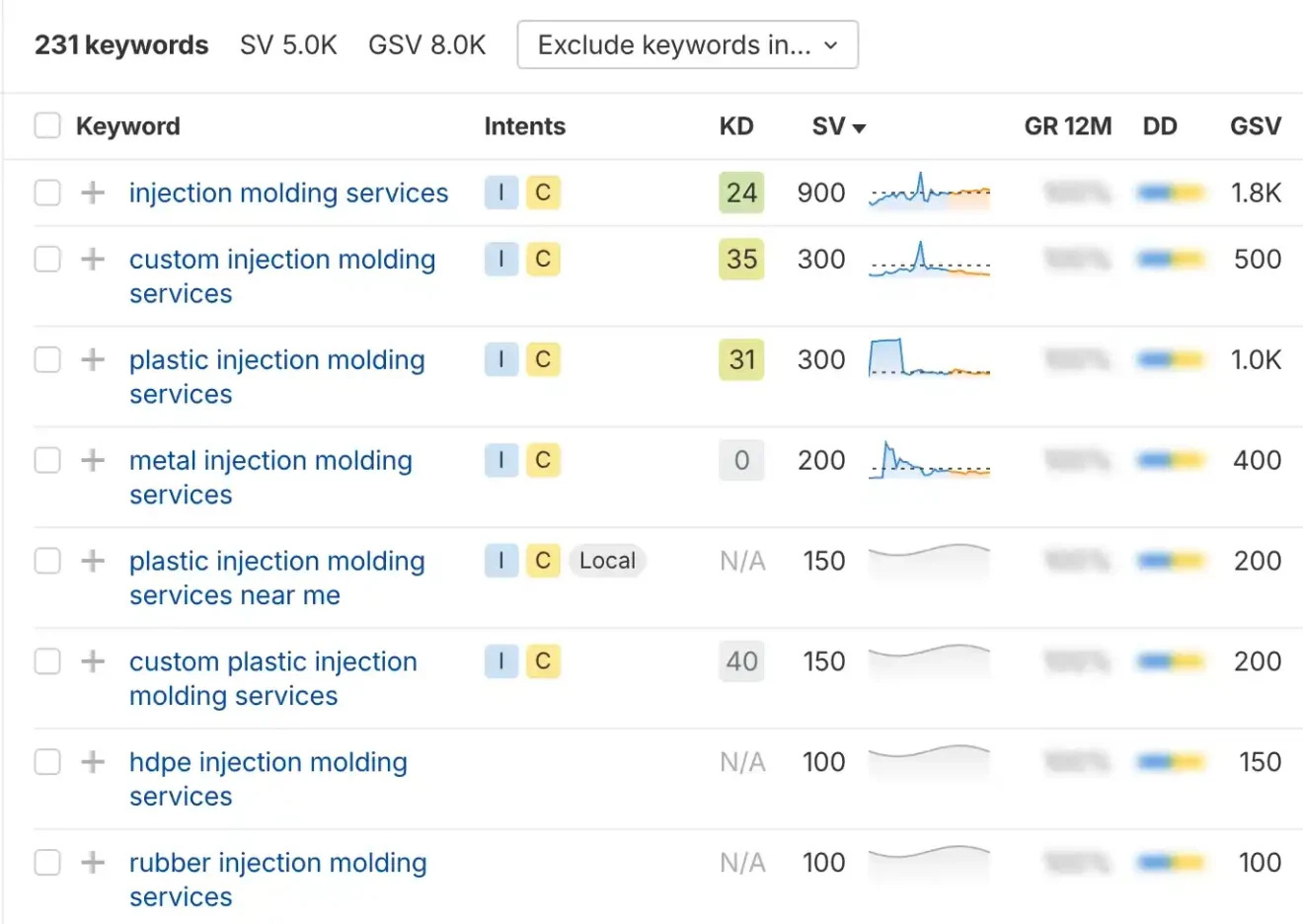
Next, prioritize the top services with the highest B2B SEO ROI and build a dedicated content hub for each service.
For example, if we pick a service such as “laser cutting,” you can cover a bunch of topic ideas, from “how does laser cutting work” to “how much is a laser cutting machine,” and so on.
Create Product and Component Pages With Technical Depth
For eCommerce stores, I would highly recommend building dedicated pages for specific products, parts, components, or materials instead of relying on one broad “Products” or “Collections” page.
For example, a company that makes rubber products shouldn’t only have a general “Rubber Products” page. It may also need separate pages for custom rubber gaskets, silicone gaskets, EPDM gaskets, rubber seals, molded rubber parts, and rubber components for specific industries.
Each page can target a more specific keyword and speak directly to the buyer’s need. Someone searching for “custom rubber gasket manufacturer” is much closer to requesting a quote than someone searching for a broad term like “rubber products.”
Remember, many manufacturing keywords are low-volume but high-intent. A keyword may only have 20, 50, or 100 searches per month, but if the searcher is a procurement manager, engineer, product developer, or operations lead, one lead can be worth a lot.
By the way, if you’re looking for a B2B eCommerce SEO checklist, you can check my guide below.
Target Industry-Specific Landing Pages
Lol, there is nothing new here, but I could not skip this part (Who knows, maybe you have no idea about SEO).
First of all, let me provide an example related to my industry.
In our case, we serve different audiences, from manufacturers and accounting teams to B2B SaaS companies, because they all fall into the B2B sector. That’s why we created dedicated pages for each of them.
I’m sure you also prioritize some sectors, and yeah, this is also an opportunity.
You can create pages like “Aerospace Parts Manufacturing,” “Medical Device Component Manufacturing,” “Automotive Parts Supplier,” or “Food Processing Equipment Manufacturer.”
Just make sure you’re not turning it into a programmatic SEO game with thin data and zero personalization. Otherwise, you won’t enjoy the fruits.
For each industry page, make sure you do strong copywriting with expert review, where you cover everything from client FAQs and benefits to specifications, use cases, and real client language.
Turn PDF Catalogs Into SEO-Friendly Web Pages
Don’t tell me that you don’t have PDF catalogs, product sheets, technical brochures, spec documents, safety data sheets, installation guides, and downloadable line cards.
I know that in many cases, these PDFs were created for sales teams, distributors, trade shows, or procurement conversations, so they contain useful details like product dimensions, materials, part numbers, use cases, certifications, tolerances, diagrams, and technical specifications.
The problem is that this information often stays hidden inside downloadable files instead of being turned into pages that search engines can easily understand, rank, and connect with the rest of the website.
I mean, Google can index many PDFs, but a PDF is usually not as flexible as a proper SEO page. It is harder to optimize the page title, headings, internal links, CTAs, schema, related products, FAQs, and conversion paths.
Especially today, it is becoming more important for AI search and LLM visibility.
So, strategy #4 – turn PDFs into web pages, my friend.
Build Material-Based Pages
As you see, most of our manufacturing SEO strategies are around dedicated pages, and for a good reason.
As I said, SEO is simple if you don’t overcomplicate it.
So, I’m sure you’re already guessing that building material-based pages on your manufacturing website is another killer strategy if you want to dominate organic results and even get cited inside LLMs.
But again, let’s go with examples.
You can create pages around searches like “stainless steel fabrication,” “aluminum CNC machining services,” “plastic injection molding materials,” or “carbon steel components.”
Believe me, those are low-hanging fruit, and you can win the SERPs if you know how to find B2B keywords and where to target them.
The keyword “aluminum cnc machining services”, for example, has low competition, and at least 2 page-level domains have below 10 DR.
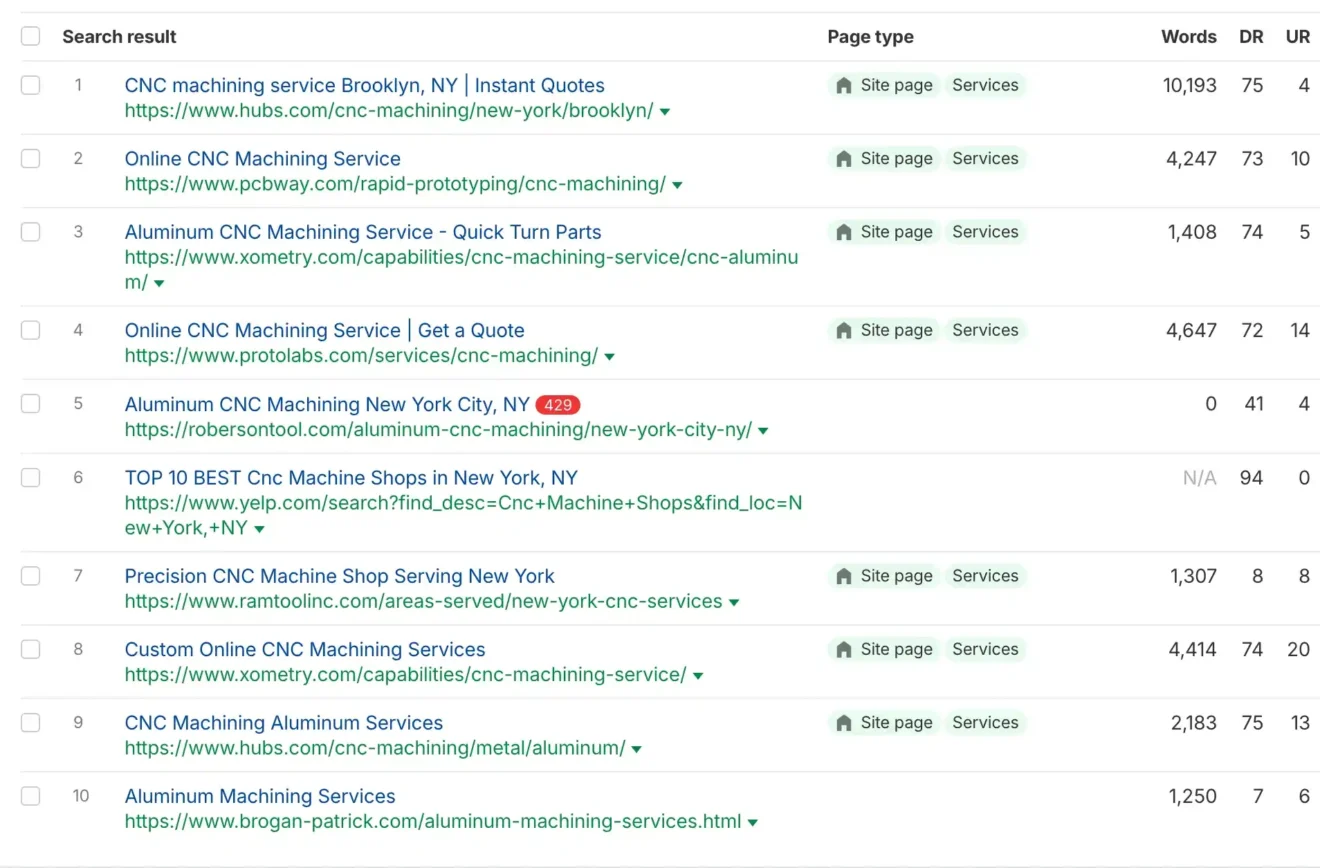
Promising, right? I think so.
Use Case Studies to Support Commercial Pages
You should not always care about search engines, keyword volumes, or traffic. Remember, when you care about your audience, clients, and readers, search engines reward you more than if you just cover anything with search volume.
On our website, we have dozens of B2B-related topics, B2B SEO case studies, and some of them don’t even have search volume.
But I’m sure those are topics my audience is hungry for, and I’m just sharing my knowledge with them because I find it valuable. This one is more like a tip than a strategy, but I thought it had to be on our list.
If you want to improve your SEO, it’s not always enough to follow common SEO trends or best practices. You should provide anything your potential leads are looking for, and yeah, I’m talking about case studies.
Track SEO by RFQs, Calls, Quote Page Visits, and Qualified Leads
It’s not smart anymore to look only at GSC data to figure out whether your B2B SEO agency’s efforts are paying off. Today, you might get leads and traffic from AI Overviews, LLMs, Bing, Google, and even YouTube if you create videos.
Sometimes, ChatGPT can recommend your brand with just a brand mention, and after a few weeks, the same potential client can visit your site directly.
So, my last tip is about tracking SEO by not just traffic, but also other metrics that show business impact.
Here are the top KPIs you should track and set up for your manufacturing SEO campaign (especially if you’re running a B2B enterprise SEO campaign, be extra careful).
Top Manufacturing SEO KPIs to Track
The goal is to track whether your SEO campaign is attracting the right buyers, ranking for valuable product and service terms, and turning technical search demand into RFQs, quote requests, calls, and qualified sales conversations.
| KPI | Importance | Accuracy Level |
|---|---|---|
| Organic RFQs / Quote Requests | Shows whether SEO is generating sales opportunities from manufacturers, distributors, procurement teams, or industrial buyers. | Very High |
| Organic Leads by Page Type | Helps you see which pages drive the best leads, such as service pages, product pages, industry pages, material pages, or case studies. | High |
| Keyword Rankings for High-Intent Terms | Shows whether you are improving for valuable terms like CNC machining services, custom parts manufacturer, or metal fabrication company. | High |
| Organic Traffic to Commercial Pages | Tracks whether your most important money pages are getting more qualified search traffic. | High |
| Organic Conversion Rate | Shows how well organic visitors turn into RFQs, calls, contact form submissions, file uploads, or quote requests. | Very High |
| SEO Pipeline / Assisted Revenue | Connects SEO to quotes, sales conversations, opportunities, and closed deals. This is the strongest business KPI, but it needs good CRM tracking. | Medium-High |
| AI Visibility | Tracks whether your manufacturing brand appears in AI Overviews, ChatGPT, Perplexity, Gemini, Copilot, and other AI search results for product, service, supplier, and industry-related queries. | Medium |
How Manufacturing Companies Can Improve AI Visibility
LLMs, or AI search engines, are evolving every day. There are a lot of confusing parts right now. If you listen to ten different experts, you’ll probably hear ten completely different things.
Google says AI SEO is the same as SEO. Many famous experts say they ran surveys and found some interesting data (IMO, most of it is fake).
So I want to start with something like this: the main principles of AI SEO are the same as regular SEO. However, there are some extra tactics you can apply to your business if you want to optimize for LLMs.
Manufacturing LLM Optimization Checklist
LLM optimization for manufacturing is mostly about making your company easier for AI systems to understand, trust, and mention.
| LLM Optimization Checklist | What to Optimize |
|---|---|
| Clear manufacturer identity | Make it obvious whether you are a contract manufacturer, OEM supplier, component manufacturer, fabrication shop, distributor, or full-service production partner. |
| Product and component clarity | Create detailed pages for the parts, components, products, assemblies, or equipment you manufacture, not just broad service pages. |
| Industry-specific context | Build pages for the industries you serve, such as aerospace, automotive, medical devices, electronics, packaging, energy, or construction. |
| Answer-ready technical content | Add direct answers to questions about lead times, MOQs, certifications, tolerances, prototyping, production runs, pricing factors, and RFQ requirements. |
| Case studies and proof signals | Publish project examples, before-and-after production challenges, quality results, client industries, delivery timelines, and measurable outcomes. |
| Structured data and clean formatting | Use clear headings, tables, FAQs, schema, internal links, author/company details, and crawlable HTML instead of hiding key details inside PDFs. |
| Third-party brand mentions | Earn mentions from industry directories, trade publications, supplier lists, engineering blogs, partner pages, and manufacturing associations. |
| Consistent company information | Keep your company name, category, services, location, certifications, industries, and supplier positioning consistent across the web. |
As you see, I don’t say these are specific tips only for manufacturing brands. I say you can apply these tactics if you want to improve your firm’s LLM visibility.
I mean, if we’re talking about B2B SaaS SEO or another industry like that, I might separate a few tactics. But in the case of manufacturing, everything I listed above can also help you improve your AI visibility.
Link-Building for Manufacturing Firms
Link-building is one of the core processes in SEO, and manufacturing firms are not an exception.
The most important thing here is to make sure you focus on relevance and quality instead of spammy tactics such as PBNs, forums, or link farms.
Actually, I have a very good guide on B2B link-building, and I’m sure you’ll find a lot of insightful stuff there.
However, if you’re looking for some expert advice specifically for manufacturing link-building, keep reading.
Your everyday process should look like this:
Link-Building Process for Manufacturing Firms
A practical process for earning industry-relevant backlinks that support product visibility, trust, and qualified B2B leads.
Audit Current Backlinks & Competitors
Start by reviewing your existing backlink profile, strongest pages, competitor links, industry publications, supplier mentions, and lost link opportunities.
Link gaps and opportunities mappedChoose the Right Target Pages
Prioritize the pages that can drive business value, such as product pages, component pages, service pages, industry pages, case studies, and technical resources.
Revenue-focused URLs selectedBuild Manufacturing-Relevant Prospect Lists
Find niche websites, trade publications, engineering blogs, supplier directories, industry associations, partner pages, and procurement-related resources.
Relevant prospects collectedCreate Linkable Technical Assets
Build useful assets like spec guides, comparison pages, material guides, CAD resource pages, process explainers, cost guides, and industry data pages.
Link-worthy assets preparedRun Personalized Outreach
Pitch each prospect with a clear reason to link, based on their audience, article topic, product category, technical need, or existing resource gap.
Outreach angles customizedTrack Link Quality & SEO Impact
Monitor link relevance, placement quality, anchor text, referral traffic, rankings, indexation, and whether linked pages support leads or quote requests.
Links tied to SEO and pipelineBased on our experience, I’d confidently say that there aren’t hundreds of opportunities out there when you decide to keep strict relevance and quality.
So, your #1 goal should be increasing the overall domain reputation and authority while also building linkable assets, so you can earn links organically over time.
Otherwise, even if you hire the best B2B SEO agency, you’re still going to face some challenges.
Top Link-Building Techniques for Manufacturing Firms
Manufacturing link-building works best when the links come from relevant, industry-specific sources.
| Link-Building Technique | How It Helps Manufacturing SEO |
|---|---|
| Industry guest posts | Publish useful articles on engineering, manufacturing, industrial, construction, logistics, or niche trade websites to earn relevant backlinks. |
| Supplier and partner links | Get listed on supplier pages, partner pages, distributor websites, vendor pages, and association member directories. |
| Trade publication mentions | Pitch expert quotes, technical insights, project stories, or manufacturing trend commentary to niche publications. |
| Linkable technical assets | Create useful resources such as material guides, tolerance charts, cost calculators, process comparisons, or manufacturing statistics pages. |
| Case study promotion | Turn projects into case studies and promote them to industry blogs, client partners, associations, and niche media sites. |
Local SEO Tips for Manufacturing Companies
First things first, if you’re a beginner without any clue about local B2B SEO, check out my guide first, because I’m not going to recycle the same strategies and tips here.
I mean, of course, you should optimize your Google Business Profile, use photos from the real facility, build local backlinks from relevant organizations if possible, and so on.
However, once you’ve built the main local SEO foundation, here are some manufacturing local SEO tips you should apply right away.
-
1
Build location pages for your service areas
If you serve several cities, states, industrial zones, or regions, create pages for the important ones. Make each page specific with local industries served, logistics details, delivery coverage, certifications, and nearby project examples.
-
2
Optimize GBP for industrial buyers
Add the right business category, service areas, product photos, facility photos, opening hours, and a clear description of what you manufacture. For manufacturers, photos of machinery, production lines, warehouse space, and finished products can build trust fast.
-
3
Create pages for local industries you serve
Instead of only targeting broad manufacturing keywords, build pages around local buyer segments. For example, “metal fabrication for construction companies in [city]” or “custom packaging manufacturer for food brands in [region].”
-
4
Turn local projects into case studies
Show completed work by region, client type, material, product category, or industry. A local case study can prove that you understand nearby regulations, delivery timelines, supply chain needs, and industry requirements.
-
5
Use local trust signals on key pages
Add certifications, licenses, association memberships, facility location, service radius, delivery areas, client logos, reviews, safety standards, and years in business.
-
6
Build links from regional business sources
Try to earn mentions from local chambers, supplier directories, trade associations, industrial parks, local news sites, partner pages, event pages, and vendor lists.
Manufacturing SEO Audit: Where to Focus First
Frankly, 90% of the B2B SEO audit checklist is the same regardless of the industry or niche. I mean, again, you need to run an on-page SEO analysis, technical SEO audit, content review, backlink profile analysis, and so on.
As you see, I’m not trying to make my article longer or something. It is what it is.
However, there are some areas where you can focus most of your effort because I’m sure your competitors don’t.
I’m talking about UX, website functionality, CTAs, and blog content.
These are the key areas our agency usually notices that clients are missing when they first come to us. Again, maybe because they’re swamped.
If I were you, I would prioritize my manufacturing SEO audit to-do list like this:
Our Agency's Checklist
For a deeper manufacturing SEO audit, don’t stop at basic technical fixes or blog performance. The biggest wins usually come from improving how well the site explains technical capabilities, supplier fit, industry relevance, and buyer conversion paths.
| Audit Area | What to Check First |
|---|---|
| Product and capability gap analysis | Compare your current pages against what buyers search for, including specific components, materials, tolerances, production methods, finishes, and custom manufacturing needs. |
| RFQ journey audit | Review the full path from organic landing page to quote request. Check forms, file upload options, technical fields, CTA placement, trust signals, and how easy it is for engineers or buyers to send specs. |
| Industry page depth | Audit whether each industry page explains use cases, production requirements, compliance needs, materials, examples, and why your company is a strong fit for that sector. |
| Technical content extraction from PDFs | Check whether important details are trapped inside catalogs, brochures, spec sheets, or datasheets instead of being turned into crawlable SEO pages. |
| Entity and AI visibility audit | Review whether Google and LLMs can clearly understand your company type, services, products, locations, certifications, industries served, and supplier positioning. |
| Commercial internal linking audit | Check whether service, product, material, industry, case study, and RFQ pages are connected in a way that supports rankings and helps buyers move toward conversion. |
How to Measure Manufacturing SEO Results
First things first, you need an agency that understands traffic is not money yet.
Next, you need an agency that knows how to turn traffic into leads and pipeline, and most importantly, how to measure it.
Do you agree with me? I hope so.
But before we move forward, let’s understand the average timeline when SEO starts showing results for new and established websites.
Established vs. New Website
First Signs
3–6 months
1–3 months
Indexing
Slower and less predictable
Usually faster
Ranking Movement
Small keyword wins first
Existing pages can improve faster
Traffic Growth
Usually starts slowly
Can grow from updates and quick fixes
Best Early Wins
Long-tail keywords, niche pages, local terms
Content refreshes, internal links, title updates
If you want to measure the results of your manufacturing SEO campaign, you should first understand what you need to measure.
And if you want to measure it properly, you should set up the right tracking systems in your CRM, keyword tracking tool, such as AgencyAnalytics, GA4, GSC, and even tools like Linkody to see your backlink profile growth over time.
In this article (above), I already covered the top KPIs you should track. But I’d like to end this section with one piece of advice that cost me a few years of learning.
It’s not possible to track everything 100%. Remember, it’s just not possible.
Instead, try to measure the overall average: rankings, leads, estimated AI visibility, organic growth, and stuff like that.
Is SEO Worth It for Manufacturing Companies?
Yes, SEO is definitely worth it for manufacturing companies, but only if you do it with the right expectations.
If you think SEO is something where you publish a few blog posts, build a few backlinks, and suddenly start getting hundreds of qualified leads, no, it doesn’t work like that.
Manufacturing SEO usually takes time because you’re dealing with a B2B audience, longer sales cycles, technical products or services, and decision-makers who don’t buy after reading one blog post.
Should Manufacturers Create Blog Content?
Yes, manufacturers should create blog content. Why not? The thing is that sometimes they hear that “content is important for SEO,” so they start publishing random topics like “What Is Manufacturing?” or “Top Benefits of Quality Control,” and after a few months, they wonder why nothing serious happens.
In my opinion, blog content for manufacturing companies should have a clear purpose.
Some blog posts should help you attract potential buyers at the early research stage. Some should support your service pages. Some should answer technical questions that your sales team hears all the time.
Some should build trust. Some should help you get mentioned inside AI search engines, and some should work as linkable assets over time.
Written by
Ashot NanayanSEO Strategist
Ashot Nanayan is an SEO strategist and the founder of B2BSEO.io. He helps B2B companies build search systems that do more than rank pages. His approach connects Google visibility, AI search presence, content depth, authority, and buyer intent, so brands appear where serious decisions start.