10 Field-Tested SEO Strategies for Oil & Gas Companies

Ashot Nanayan
SEO Strategist
Table of content
In oil and gas SEO, things are not as easy as they seem at first glance. While a typical retail brand might fight for clicks on “best hiking boots,” your battlefield is defined by multi-million dollar procurement cycles, hyper-technical specifications, and a global supply chain that never sleeps.
I have been doing SEO for B2B companies for over seven years. Throughout my career, I’ve helped complex industrial firms navigate the shift from “handshake-only” deals to a digital-first reality. If there is one thing I have learned, it’s that the energy sector plays by an entirely different set of rules.
I’ve compiled this playbook to share the exact, field-tested strategies our specialized B2B SEO agency uses to help oil and gas firms outmaneuver the competition and secure a seat at the table for the industry’s most lucrative contracts.
Ready to grow smarter?
Book a free 30-minute strategy call with our team. We'll audit your search visibility and build a custom action plan.
1. Build “Spec-Level” Landing Pages
One of the biggest SEO mistakes I see in oil & gas company sites is that they have one generic “Oilfield Services” or “Pipeline Solutions” page and expect serious engineers and procurement teams to get excited about it.
I mean, okay, I don’t argue; most of them don’t care, but it’s a great opportunity for you.
Instead of a generic services page, build space-level landing pages like:
- Pipeline integrity management services
- API 570 inspection contractor for refineries
- Turnaround planning and shutdown management
On every page, go deeper than “we provide high-quality services.”
Talk their language. Mention which standards you work under (API 570, API 653, ASME, local regulations, ISO standards).
Design is very important here more than most owners realize. In these industries, I swear half the business owners barely remember they even have a website.
If you can give them clean layouts, readable typography, good imagery, and clear structure around each service space, you’re instantly 10 steps ahead of most competitors in your region.
One important point from a B2B SEO angle: a lot of these “space-level” keywords will show very small to zero volume in typical SEO tools. That doesn’t mean they’re useless.
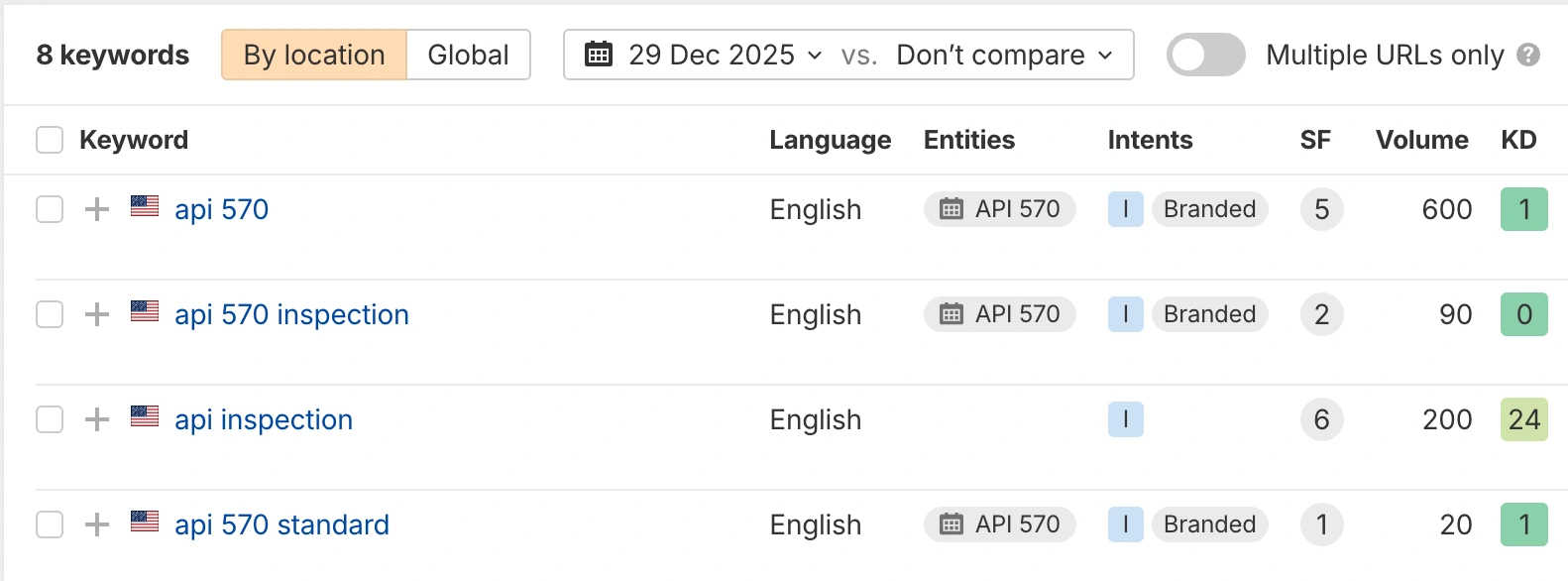
In the oil & gas industry, a single “API 570 inspection contractor for refineries” lead can result in a six- or seven-figure contract over the lifetime of the relationship.
To find these commercial keywords, I wouldn’t rely too much on traditional SEO tools alone. Most of them won’t even show decent volume for this level of specificity.
Instead, start from the industry and your competitors. Look at how your best competitors describe their services, how engineers name specific inspections, and how procurement teams talk about projects internally.
You can also plug a few broad terms into tools like AnswerThePublic (By the way, I talk about it in my B2B keyword research guide) to get phrases people search for.
On top of that, check the search results themselves: the “related searches” at the bottom and suggestions at the top of Google can give you a lot of high-intent ideas you’ll never see in a regular keyword report.
2. Track AI Exposure as Seriously as Rankings
When you sit down with your partners or clients next time, ask them one simple question: “How many times a day do you ask ChatGPT (or any other AI search engine) to find a solution, a vendor, or a tool?”
In my experience, the honest answer is: a lot. Engineers, consultants, and even procurement teams are quietly using AI assistants to shortlist vendors, check standards, and compare options long before they ever fill out a contact form.
In my SEO trends and predictions guide, I’ve already said this very clearly: optimizing for AI search engines is no longer optional in 2026. Google is still huge, but ignoring AI exposure now is like ignoring mobile search 10 years ago.
The right time to start optimizing for LLMs was yesterday. The second-best time is today.
For oil & gas companies, I’d approach “AI exposure” almost like a separate KPI next to rankings and traffic.
How often does your company appear when someone asks an AI tool about “best API 570 inspection contractors,” “pipeline integrity management firms in [region],” or “top turnaround planning companies for petrochemical plants”?
If you have no idea, that’s your first red flag.
I usually start with an SEO audit for LLMs: how clearly is your company described online, how strong are your mentions on trusted industry sites, how good is your content structure, and how easy is it for an AI model to understand who you are and what you specialize in?
I use my own checklist for this:
-
1
Make your service expertise extremely clear
Oil and gas buyers often search for very specific capabilities, not generic “energy solutions.” Create detailed pages for drilling support, pipeline services, equipment supply, inspection, maintenance, engineering, logistics, compliance, and every high-value service you provide.
-
2
Strengthen third-party authority signals
AI systems don't only look at your website. Industry directories, association pages, partner mentions, trade publications, awards, case studies, and PR coverage help connect your brand with the right oil and gas category.
-
3
Optimize for regional and industrial intent
Many oil and gas searches are tied to locations, basins, ports, refineries, plants, offshore regions, and service areas. Build pages that connect your services to the markets and operating environments where your buyers need support.
-
4
Keep brand and entity information consistent
Your company name, services, leadership, address, certifications, licenses, phone number, locations, and industry categories should match across your website, Google Business Profile, LinkedIn, directories, and trade sites. Consistency makes your brand easier for LLMs to understand and recommend.
If you need help, my oil & gas SEO agency is focused on this kind of AI SEO work.
But even before you bring anyone in, you can start with the basics: tighten your website structure around services and locations, publish in-depth content that solves technical problems, get mentioned in authoritative industry articles and listicles, and invest in digital PR that puts your brand in the places AI tools crawl and trust.
If you do that consistently, your name won’t just appear in Google; it will start appearing in the answers your buyers read before they ever open Google.
3. Target the “Upstream / Midstream / Downstream” Chain
Most oil & gas websites have this sad little menu item called “Industries → Oil & Gas,” and that’s it. One page trying to speak to everyone from exploration geos to terminal managers.
In reality, your buyers don’t see themselves as just “oil & gas.” They live in upstream, midstream, or downstream teams, with different problems, standards, budgets, and languages.
So instead of one generic “oil & gas” page, split it like this:
- Upstream: exploration, drilling, completions, production
- Midstream: pipelines, storage, transport, compression
- Downstream: refining, distribution, terminals, retail support
For each segment, build one deep pillar page that gives a proper overview: where you fit in the chain, what typical challenges you solve, who your work touches (operations, integrity, HSE, finance), what regulations matter, and what a typical project looks like from first call to final report.
Then, under each pillar, add focused sub-pages for specific tasks. From an SEO and UX angle, a few things I’ve seen work really well:
You’re basically rebuilding your site around how the industry already thinks: upstream, midstream, downstream. Most competitors won’t bother, and that’s why you should.
4. Turn Field Experience Into Searchable “Failure Stories”
Engineers don’t Google “best integrity consulting company.” They Google their pain. Things like “API 653 tank settlement issues,” “gas compressor surge case study,” or “corrosion under insulation examples on carbon steel piping.”
If your website doesn’t speak that language, you’re invisible at the exact moment they’re desperate for help.
Take the failures you’ve seen and turn them into searchable case stories. For example, one page per failure type. You can show stuff like parameters (as much as you safely can): operating pressures, temperatures, materials, environment, age of asset, time to failure, what early warning signs were missed, and what you found during the investigation.
You can keep client names confidential and still be specific. For example: “A 30-year-old crude storage tank in a coastal terminal with significant settlement on one side, operating at X pressure and Y product, inspected to API 653…”
Then walk through what went wrong, what you changed, and roughly what it saved in terms of risk, downtime, or capex. That’s a detail that makes an integrity engineer stop scrolling and think, “Okay, these people know what they’re doing.”
From an SEO standpoint, this is insanely powerful B2B SEO content. It hits failure-mode keywords, builds trust, and gives you a natural way to target phrases your competitors don’t even think about.
From an LLM/AI angle, this type of structured, specific case material is what helps tools like AI Overviews, ChatGPT “remember” your brand when someone asks, “How do you deal with X type of failure?”
5. Use Schema Markup
Schema by itself isn’t a “ranking factor.” Google isn’t going to say, “Oh, they added FAQ schema, let’s give them +10 positions.”
That’s not how it works. But a lot of B2B companies in niche spaces (including oil & gas) report the same pattern: better click-through rates, more trust on the SERP, and more visibility in AI search engines like ChatGPT or Gemini once their structured data is in decent shape.
For oil & gas, I’d look at the schema this way:
Make it clear who you are:
Use things like Organization (or LocalBusiness if you have strong regional offices) and fill them properly:
This way, you’re basically giving search engines and LLMs a clean “business card” that says: this is the same company that appears in Clutch, on that conference speaker list, on that association website, etc.
Here is an example of an Organization schema (You can find the different types of schemas here):
Organization Schema Markup
Here’s a clean default Organization schema markup for an oil and gas company. Replace the placeholders with your company details.
  "@context": "https://schema.org",
  "@type": "Organization",
  "name": "Company Name",
  "url": "https://www.example.com",
  "logo": "https://www.example.com/logo.png",
  "description": "Company Name is an oil and gas company providing energy, exploration, production, drilling, field services, and related solutions for industrial and commercial clients.",
  "foundingDate": "2000",
  "industry": "Oil and Gas",
  "slogan": "Reliable energy solutions for modern industry.",
  "telephone": "+1-000-000-0000",
  "email": "[email protected]",
  "address": {
    "@type": "PostalAddress",
    "streetAddress": "123 Business Street",
    "addressLocality": "Houston",
    "addressRegion": "TX",
    "postalCode": "77002",
    "addressCountry": "US"
  },
  "areaServed": [
    {
      "@type": "Country",
      "name": "United States"
    }
  ],
  "sameAs": [
    "https://www.linkedin.com/company/company-name",
    "https://www.facebook.com/company-name",
    "https://twitter.com/company-name"
  ],
  "contactPoint": [
    {
      "@type": "ContactPoint",
      "telephone": "+1-000-000-0000",
      "contactType": "Sales",
      "email": "[email protected]",
      "areaServed": "US",
      "availableLanguage": ["English"]
    },
    {
      "@type": "ContactPoint",
      "telephone": "+1-000-000-0000",
      "contactType": "Customer Support",
      "email": "[email protected]",
      "areaServed": "US",
      "availableLanguage": ["English"]
    }
  ],
  "knowsAbout": [
    "Oil and gas",
    "Energy services",
    "Exploration and production",
    "Drilling services",
    "Petroleum engineering",
    "Natural gas",
    "Upstream oil and gas",
    "Midstream oil and gas",
    "Industrial energy solutions"
  ]
}
A few extra things that work well in this space:
Tie services to industries and segments using about and areaServed. If a service is clearly tied to “midstream pipeline transport in North America,” say it in the structured data as well, not just in the heading.
For case studies and failure stories, use Article or TechArticle and be explicit about what the piece is about: API 653 tank issues, compressor surge investigation, CUI on insulated lines, etc.
If you have SMEs (integrity engineers, corrosion specialists, process engineers) who write or sign off on content, mark them up with Person and connect them to the Organization.
6. Build “Tender / Prequalification” Content and Funnels
A lot of serious oil & gas work never starts with “contact us.” It starts with pre-qualification and tender lists. If your website doesn’t help a busy procurement person tick those boxes faster, you’re making their life harder, and they’ll quietly move on to someone else.
So, instead of hiding all that behind email chains, build dedicated tender / pre-qualification pages, for example:
- Vendor pre-qualification for major IOC/NOC projects
- Approved contractor for [Operator] in [Region] (only if it’s true)
- HSE & QA/QC documentation for oil & gas projects
-
1
Make Compliance Documents Easy to Request
Offer downloadable compliance packs such as HSE policies, QA/QC procedures, sample method statements, insurance certificates, ISO certifications, and similar documents behind a simple form.
-
2
Show Relevant Project Experience by Asset Type
Summarize your track record by project type, including pipelines, tanks, terminals, refineries, offshore assets, gas plants, and other relevant oil and gas environments.
-
3
Explain the Vendor Onboarding Process Clearly
Walk buyers through the process step by step, from NDA and document exchange to vendor registration, trial projects, framework agreements, and long-term procurement approval.
The goal is to make a procurement or contracts person think, “If I put these guys in the bid list, they won’t embarrass me internally.”
7. Own “ESG + Safety + Compliance” Search in Your Niche
Oil and gas SEO is its own universe. I always say you can’t really compare it to e-commerce, SaaS, or “normal” B2B local SEO. I mean, the way people search and the way decisions are made are completely different.
You often can’t rely on keyword volumes, and in many cases, your “competitors” aren’t even doing proper SEO, so copying them makes no sense.
One of the biggest blind spots I see is ESG, safety, and compliance.
A lot of operators are under pressure to report on emissions reductions, safety performance, environmental impact, and regulatory alignment. If your services touch any of that, there’s a huge opportunity to own that space in search.
Instead of only trying to rank for “country + oil and gas services,” build content around the pressure points your clients live with every day.
Things like how to reduce fugitive emissions in a specific type of process unit, best practices for flare optimization and emissions reporting, or detailed explanations of how you help operators meet a particular local regulation or environmental standard.
8. Map Your Strategy to Basins and Industrial Zones
I know you always need more, so here is another killer strategy from one of the best B2B SEO agencies. Work doesn’t really happen at the “country” level. It happens in basins, offshore blocks, corridors, and industrial zones.
But most sites still aim for stuff like “USA oil and gas services”, don’t they?
However, instead of just “Country + oil and gas services,” go more granular. For instance, pages like “Oilfield services in the Permian Basin,” “Pipeline integrity services in the North Sea,” “LNG terminal maintenance in [specific port],” “Tank inspection services in the Gulf Coast petrochemical corridor.”
For each region, create dedicated local pages that show you understand that environment. Talk about typical operators in the area (without breaking NDAs), the usual conditions you see there, common failure modes in that climate, and the standards or local requirements that really matter.
Add project examples from that basin or zone. Even if they’re anonymized, explain what you did, what was unique about that area, and what outcomes you delivered.
It also helps to build geo-specific FAQs on those pages.
9. Do B2B Link-Building
It’s not by chance I keep saying B2B link-building and not just “link building.” The usual playbook of spraying guest posts on random blogs and dropping links in low-quality articles doesn’t move the needle in oil and gas.
You need the mentions that feel more like digital PR than “we paid someone $100 for a blog link.”
For example, case studies published with technology partners, joint articles with equipment manufacturers, speaking slots that finish up on conference websites, expert commentary in oil and gas magazines, ESG and safety resources that reference your frameworks, and inclusion in “recommended vendors” or “trusted partners” lists.
That’s why I usually recommend building a proper B2B link-building strategy, not a quick “10 links per month” package.
10. Leverage International SEO (If Applicable)
If your business works across borders, you can also leverage international B2B SEO (Lower competition, I bet). But I’m not going to dive into the technical stuff like hreflang and URL structures here.
Instead, let me tell you some more important stuff.
Oil and gas already has its own jargon in English, and each country adds its own extra complexity on top of that. The way a German integrity engineer describes a pipeline issue is not the same as someone in Brazil or the Middle East.
So before you even think about “scaling” content, you need to dig into how people in that market talk.
I’d always recommend having at least one native speaker with technical understanding review or rewrite your key pages. Not just “fix the grammar,” but check whether the tone, claims, and examples make sense culturally and technically.
Sometimes a phrase that sounds fine in English comes across as arrogant, vague, or just not credible in another market.
Pro tip: Test the waters with paid campaigns first. Run a small PPC campaign in that language and send traffic to a few localized landing pages or even draft versions.
Watch what gets clicks, where people stay, what they bounce on, and which messages get any engagement at all.
I’m not even talking about full B2B SEO ROI here, because in this industry, it can take a long time for a lead to turn into real revenue.
How to Optimize Your Oil & Gas Company for LLMs
In the next few years, a lot of your bigger clients will use ChatGPT or Gemini on their phone and just ask, “Compare the best oil and gas contractors for X in Y region” instead of opening ten tabs and doing their own research.
Here is my list:
LLM Visibility Is Not a Guaranteed Outcome
These strategies come from our experience working with SEO, content, and visibility systems across competitive B2B markets. They are not guaranteed rankings or AI mentions, but they give oil and gas companies a stronger foundation for being understood, cited, and considered by search engines and LLMs.
| Optimization Area | What to Do | Why It Helps LLM Visibility |
|---|---|---|
| Get Mentioned in Industry Lists | Earn placements in “top oil and gas contractors,” “pipeline service companies,” or “industrial maintenance companies” articles. | LLMs often pull recommendations from listicles, directories, and comparison-style content. |
| Use Structured Data | Add Organization, LocalBusiness, Service, FAQ, Breadcrumb, and Article schema where relevant. | Schema helps search engines and AI systems understand your business details more cleanly. |
| Answer Procurement Questions | Create content around vendor onboarding, required documents, insurance, safety records, project timelines, and quote requests. | B2B buyers often use AI tools to shortlist vendors before they contact anyone. |
| Build Strong Author and Leadership Pages | Add expert profiles for founders, engineers, HSE managers, project managers, and technical specialists. | Real expertise helps support trust, especially in technical and high-risk industries. |
| Target Long, Specific Questions | Build content around questions like “How to choose an oil and gas maintenance contractor?” or “What documents are needed for vendor registration?” | LLMs are built around natural-language questions, not just short keywords. |
| Improve Third-Party Trust Signals | Keep LinkedIn, business directories, industry associations, Google Business Profile, and trade publication mentions updated. | LLMs do not only look at your website; they also connect signals from outside sources. |
The Cost of Oil & Gas SEO
Let’s talk money (My favorite part, lol), because this is where a lot of expectations go off the rails. Based on what I see in the market right now and looking ahead to 2026, a realistic budget for an oil and gas SEO campaign usually sits somewhere around $5,000 to $10,000 USD per month.
I’m talking about a proper campaign here, not “a few blog posts and a couple of random backlinks,” but a strategy that includes on-page SEO, content development, technical work, and some level of digital PR or authority building.
How to Choose an Oil & Gas SEO Agency
As the CEO and founder of B2BSEO.io, I’m on both sides of the table. I run a B2B SEO agency, but I also outsource SEO work, bring in niche SEO consultants, and partner with other agencies when it makes sense.
Especially in B2B, you quickly learn that picking the wrong partner costs you time, money, and reputation.
For oil and gas, I’d first look at their B2B mindset. They might not have twenty case studies in upstream or midstream, and that’s fine, but they should clearly understand long sales cycles, high-value leads, complex decision makers, and the fact that one good client is worth more than 10,000 random visitors.
To keep it short, I also crafted a very detailed guide on how to hire a B2B SEO agency, so you can save time, resources, and nerves.
The Key Takeaways
In this oil and gas SEO guide, I shared what’s worked for me with real clients in this space, including some serious B2B accounts. Every industry has its own headaches, and oil and gas is definitely one of the trickier ones, but if you do good work, learn from your mistakes, and keep refining your approach, you can absolutely win here.
If you’re looking for an oil & gas SEO agency that understands high-ticket B2B deals and the reality of this industry, you can always consider our services at B2BSEO.io. We can help you attract the right projects and turn your website into a growth channel.
Written by
Ashot NanayanSEO Strategist
Ashot Nanayan is an SEO strategist and the founder of B2BSEO.io. He helps B2B companies build search systems that do more than rank pages. His approach connects Google visibility, AI search presence, content depth, authority, and buyer intent, so brands appear where serious decisions start.