Accounting SEO: How to Win Search in a Trust-First Industry

Ashot Nanayan
SEO Strategist
Table of content
Accounting is one of my favorite industries, maybe because I have a bachelor’s degree in finance. Honestly, if I weren’t in SEO, I’m pretty sure I would have chosen this field.
Our agency has been providing SEO services for accountants and CPA firms for a long time, and believe me, it has never felt boring. We’ve also never tried to apply the same checklist to every company.
But first things first, if you’re looking for broader B2B SEO strategies, feel free to check out my guide. In this article, though, I’m going to share the top accounting SEO tips, strategies, and techniques we apply in our B2B SEO agency. I’ll keep everything as simple as possible, without jargon or anything unclear. Hope you enjoy it.
Ready to grow smarter?
Book a free 30-minute strategy call with our team. We'll audit your search visibility and build a custom action plan.
Strengthen Local SEO With Service + City Targeting
First of all, to avoid confusion, it’s very important to know that you can target local pages if you serve in one or more locations, or you serve nationally but don’t mind targeting location-specific keywords.
In SEO, you can do that too, even if you’re not a local business with a physical location there, and sometimes it might work. However, I wouldn’t recommend targeting every single location keyword just because it has volume (I mean, don’t create pages programmatically).
For accounting firms, local SEO makes sense when the firm mainly serves clients in a specific city, state, metro area, or nearby region.
Anyway, let’s get to the point.
Let’s say you’re an accounting firm in Las Vegas and you provide several services, from tax planning to advisory services and so on.
In this strategy, I recommend prioritizing your top services, especially the ones with higher pipeline value or better profit margins, and creating dedicated service pages with local intent.
For example, instead of only targeting the homepage for the keyword “Las Vegas accounting firm,” you can start with some keyword research and find much better opportunities.
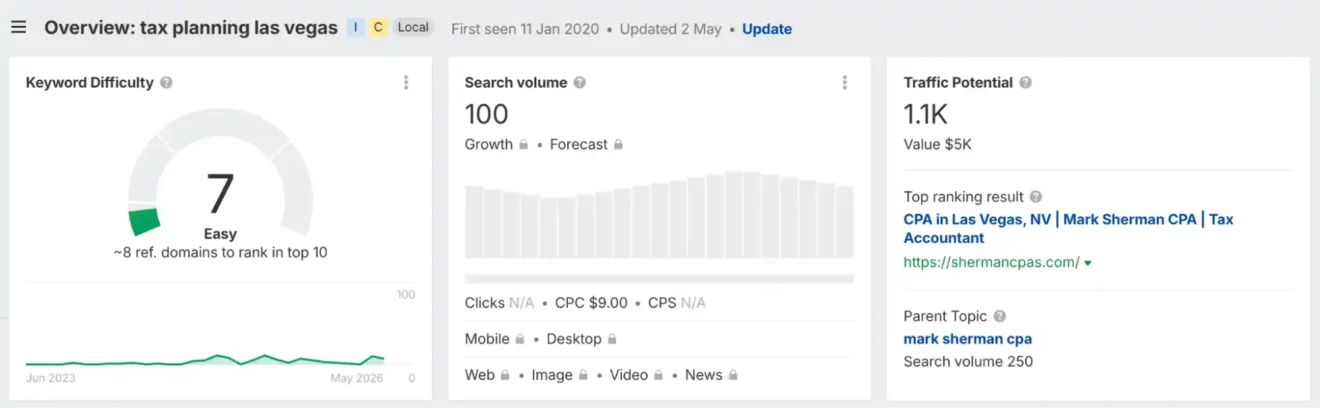
For example, you might go after the keyword “tax planning Las Vegas,” which has some search volume and almost no difficulty.
I’m sure many business owners still prefer working with someone local, or at least someone who understands their state, city, tax-related stuff, local business scene, or industry market.
So if your firm only targets national keywords, you may compete with huge websites, directories, and national firms.
Use Blog Content to Support Money Pages
Accounting and similar sectors, like finance and healthcare, fall into Google’s YMYL category, and if you have dedicated content writers who really understand the industry inside and out, I would highly recommend building a strong B2B SEO content strategy to support your money pages.
As an SEO strategist who has been working with accounting firms, I assure there are dozens of opportunities and angles to cover in this industry. It’s just important to understand how to plan everything and what to prioritize.
Pro Tip
Bad or misleading advice in such topics can affect someone’s money, trigger penalties, influence business decisions, or even create legal issues. That’s why Google usually expects much stronger trust signals here, along with expertise, credible authors, and a website that already has some authority.
For example, a new accounting firm can start with topics around bookkeeping, accounting software, invoicing, payroll basics, financial organization, cash flow tracking, monthly reporting, business expense categories, and common accounting mistakes.
These topics are still closely related to accounting, but they’re usually easier to compete for and less risky than direct tax advice.
Build Authority Niche Backlinks
In accounting, finance, and similar industries, it’s not easy to find hundreds of high-quality, niche-relevant backlinks. I’m sure that if you’re working with a “we do everything” agency or some Fiverr freelancers, they’ll probably recommend building links from irrelevant websites, PBNs, or link farms.
Again, this is not fashion or lifestyle, and if you’re doing link-building for a B2B firm, you need to be very careful when vetting opportunities.
You basically have two options. If your site is new, you usually can’t rely on earning links naturally, even if you have great content or strong statistics pages, though sometimes it’s possible if LLMs start citing your content.
So option one: pay for links.
Just make sure those links are coming from relevant websites in finance, business, and similar sectors.
At the same time, if you also want to earn high-quality PR backlinks, you can build linkable assets over time and run HARO-style link-building campaigns to pitch journalists.
Top techniques for accounting firms
Simple ways accounting firms can earn relevant backlinks
Guest posting
34
HARO
28
Niche Edits
21
Linkable assets
17
B2BSEO.io is a trusted B2B link-building agency that’s also worth considering. We prioritize relevance, authority, and business impact. You can check out dozens of case studies on our website to see that we really know our craft.
Optimize for LLM Visibility
I’m not even sure whether that’s a good or bad thing, but LLMs entered our lives so quickly that we barely noticed. Today, millions of people use ChatGPT, Gemini, and other LLMs to get answers, compare options, or solve specific tasks.
On the other hand, SEOs are now trying to optimize client websites for AI search and LLM visibility, and while a small percentage are testing, analyzing, and sometimes failing their way toward something real, 90% are just trying to sell so-called AI SEO services using the same old checklist.
Accounting firms aren’t an exception. Over the last two years, we’ve found some best practices that work.
Here’s my checklist:
-
1
Get mentioned in “best accounting firm” listicles
LLMs often pick brand names from third-party lists, comparison articles, local directories, and expert roundups. Accounting firms should work on getting included in pages like “best accounting firms for small businesses,” “top CPA firms in [city],” or “best accounting firms for startups.”
-
2
Create content that answers AI-style prompts
People ask LLMs full questions, not just keywords. Build content around prompts like “What type of accountant do I need for a SaaS business?” or “How do I choose a CPA for my construction company?” so AI tools can connect your firm to those exact scenarios.
-
3
Make your niche positioning impossible to miss
LLMs need clear context to recommend you correctly. If you specialize in startups, real estate, medical practices, construction companies, nonprofits, or high-net-worth clients, say it clearly across your website, profiles, bios, case studies, and external mentions.
-
4
Strengthen entity consistency across the web
Your firm name, partners, credentials, location, services, industries served, and contact details should match across Google Business Profile, LinkedIn, CPA directories, Clutch-style profiles, local business pages, and association listings. Conflicting information makes AI tools less confident.
-
5
Build third-party proof around your firm
Reviews, interviews, podcast appearances, local media mentions, business association profiles, awards, guest quotes, and partner pages help LLMs validate that your firm is a real trusted option, not just another website claiming expertise.
Create Industry-Specific Accounting Pages
A lot of businesses across different industries, especially the ones where there are hundreds of keyword variations to scale, go after programmatic SEO and try to target almost every possible variation.
But let me explain what I mean.
You can target a keyword and landing page like “bookkeeping services,” which is totally fine, and yes, you’ll probably pick up some related variations too, like “bookkeeping services for nonprofits.”
However, if you create dedicated industry-specific pages for the businesses you serve (E.g., bookkeeping services for startups), your chances are much higher.
Spam policies for Google web search
It’s important to note that Google has recently reinforced the idea that you cannot safely publish dozens of near-duplicate, industry-targeted pages just to rank.
In our case, for example, we only target the B2B sector, without any exception. That’s why we created specific landing pages for each industry we serve, from accounting SEO and SaaS SEO to construction, logistics, and more.
Use Problem-Based Pages for Urgent Intent
I’m sure most of your competitors are targeting the same service or location pages, and you’re probably looking for something more unique, more attractive, and with stronger potential to generate B2B leads through SEO.
As I already said in the intro, this isn’t a beginner B2B SEO guide, so here’s another great strategy for accounting brands.
Instead of only targeting service keywords like “accounting services” or “bookkeeping services,” you can target the problem behind the service. For example, someone searching “behind on bookkeeping” may not even know they need “catch-up bookkeeping services” yet. But they clearly have a problem that an accounting firm can solve.
Urgent-Intent Accounting Keywords Worth Targeting
Some accounting keywords show clear buying intent because the searcher already has a problem they need to fix.
| Urgent-Intent Keyword Idea | Why It’s Worth Targeting |
|---|---|
| Catch-up bookkeeping services | The business already knows its books are behind and may be ready to hire help. |
| Bookkeeping cleanup services | Strong commercial intent because the searcher needs someone to fix messy records. |
| QuickBooks cleanup services | Tool-specific and problem-specific, which usually means better lead quality. |
| Behind on bookkeeping | Great problem-based keyword for a blog post that can lead to a catch-up bookkeeping service page. |
| Late tax filing help | High urgency, especially around tax season or after missed deadlines. |
| IRS notice help | Sensitive but very strong intent because the user is likely stressed and needs professional support. |
| Payroll tax help | Good for businesses that may have made mistakes or missed important payroll tax steps. |
| Small business audit support | Strong BOFU keyword because the user is dealing with a serious accounting issue. |
| Need books ready for tax season | Great seasonal keyword that connects bookkeeping and tax preparation. |
| Financial statements for business loan | Practical, urgent, and often tied to a real business decision. |
Some urgent keywords deserve service landing pages because the user is already looking for help. Other keywords are better as blog posts because the user may still be trying to understand the issue.
Turn Accountant Bios Into Trust Assets
In my opinion (Also, as an agency owner), when someone is looking for an accountant, they’re also trying to understand who is behind the firm, what experience they have, what industries they know, and whether they can be trusted with sensitive financial work.
A weak bio that only says “John is a CPA with 10 years of experience” doesn’t do much. A strong bio can make the firm feel more credible before the first call happens.
The best accountant bios should clearly show credentials, years of experience, areas of expertise, industries served, certifications, and the type of clients the accountant usually helps.
For example, if someone specializes in small business bookkeeping, SaaS accounting, construction accounting, tax planning, payroll, or IRS notice support, you should make it visible on the bio page.
It also helps from an SEO and E-E-A-T perspective. As I already explained, accounting is a trust-heavy industry, so Google, other search engines, and users need clear signals that the content is connected to real professionals.
Prepare Tax-Season SEO Months Earlier
I’ve noticed with accounting SEO that many firms start thinking about tax-season content when tax season is already around the corner, and honestly, that’s usually too late, don’t you think so?
I mean, if you publish a tax preparation page in February and expect it to generate leads immediately, you’re already fighting an uphill battle. Google needs time to crawl the page, understand it, test it, and see how it fits with the rest of your website (Otherwise, run Google Ads, my friend).
For accounting firms, I’d usually start preparing tax-season content at least a few months earlier.
Here is what our process looks like:
Our Tax-Season SEO Content Process for Accounting Firms
A few months before tax season, we prepare the pages, topics, and updates that can bring in qualified search traffic when demand starts rising.
Review Last Year’s Tax Search Data
We check which tax-related pages, keywords, questions, and services performed well last season and where the website missed opportunities.
Past tax demand reviewedMap High-Intent Tax Topics
We separate general tax questions from topics that can bring leads, such as business tax filing, tax planning, IRS notices, payroll tax, and local tax help.
Past tax demand reviewedUpdate Existing Tax Pages Early
We refresh important pages with current-year details, deadlines, FAQs, internal links, service CTAs, and clearer answers before search demand peaks.
Existing pages refreshedCreate New Seasonal Content
We build new blog posts, service pages, local tax pages, checklists, and guides around the questions clients are likely to search before filing season.
Seasonal content preparedConnect Content to Consultation Requests
We add strong next steps, tax consultation CTAs, trust signals, and internal links so visitors can move from reading to booking a call.
Traffic connected to leadsHow Much Does SEO for Accountants Cost?
Overall, accounting SEO usually falls into the same pricing logic as other service-based SEO campaigns, but it often costs a bit more when you want serious content, local SEO, service pages, and an experienced agency.
Small local SEO campaigns often cost around $1800 to $3,000 per month, while broader SEO retainers across industries commonly cost around $3,000 to $5,000 per month.
For an accounting firm specifically, I’d usually think about it like this in simple terms.
If you are a small local accounting or CPA firm and mainly want the basics done well, such as local pages, service pages, on-page cleanup, Google Business Profile work, and some supporting content, you’ll often see pricing in the $1,000 to $2,500 per month range.
If you want a more aggressive campaign with accounting-specific content, industry pages, conversion-focused service pages, ongoing technical work, and authority building, a more realistic range is often $5,500 to $7,000+ per month, in my opinion.
How to Compete With Large Accounting Firms?
I know it’s not always easy to compete with large accounting firms like BDO USA, for example, that have massive marketing budgets, big teams, and more than twenty years of history. But I’m not saying it’s impossible to outrank them for some keywords.
Of course, you can go after long-tail keywords, especially if you want to improve your B2B SEO ROI, and create specific landing pages that enterprise firms usually ignore.
However, these kinds of strategies are not rare, and there’s a very high chance your competitors already know about them too.
But search engines still care a lot about niche relevance, and I believe one of the best proven ways to outrank the biggest and strongest competitors is to build highly niche-relevant content and landing pages and put your resources behind that.
In short, I’m advising you to become the big fish in a small pond.
The Bottom Line
Accounting is one of those industries where there are dozens of angles and opportunities from an SEO perspective. Especially today, with the rise of AI Overviews, LLMs, and AI agents, there’s a lot more to think about and a lot more work to do.
In this guide, I shared short, to-the-point strategies, examples, and best practices you can apply to your accounting SEO campaign to generate more leads and pipeline.
Meanwhile, if you feel like you need help or advice, from strategy to execution, you can consider our specialized accounting SEO agency for your company. Hope you enjoyed the article and found it insightful.
What Is Accounting SEO?
Accounting SEO is the process of improving an accounting firm’s visibility across Google, Bing, and AI search engines when potential clients search for the services it offers. In simple words, it means improving your website, service pages, and content so people can find your firm when they search for things like tax planning, bookkeeping, CFO services, or accounting help in their area.
Does SEO Work for Accountants?
Yes, SEO absolutely can work for accountants. People already go to Google when they need help with accounting services. So if your firm appears for the right searches, SEO can generate qualified leads who are already looking for what you offer.
What Pages Should an Accounting Website Have?
Homepage, about page, contact page, and separate service pages for the actual services the firm offers, like bookkeeping, tax planning, payroll, CFO services, or advisory work.
If the firm serves specific areas, location pages can also make sense, and if it works with certain types of businesses, industry pages can help too.
It’s also smart to have a blog or resource section to answer common questions and support SEO, plus trust-building pages like testimonials, case studies, team pages, or author pages.
How Can an Accounting Firm Rank on Google Maps?
An accounting firm can rank on Google Maps by improving its Google Business Profile and making it clear to Google where it is located, what services it offers, and how trusted it is.
You can fill out the profile, choosing the right categories, writing a strong business description, adding real photos, listing the services properly, and making sure the firm’s name, address, and phone number (NAP) are consistent across the website and other directories.
Beyond that, the website needs to support local SEO too.
Written by
Ashot NanayanSEO Strategist
Ashot Nanayan is an SEO strategist and the founder of B2BSEO.io. He helps B2B companies build search systems that do more than rank pages. His approach connects Google visibility, AI search presence, content depth, authority, and buyer intent, so brands appear where serious decisions start.