B2B SEO ROI: How to Connect Organic Search to Leads & Pipeline

Ashot Nanayan
SEO Strategist
Table of content
Based on industry research and what our team has seen across B2B client work, SEO has become one of the highest-ROI channels over time for B2B brands, but the answer depends on deal size, sales cycle length, conversion paths, and how well organic traffic is tied to the pipeline.
Recent benchmark roundups put B2B SEO ROI around 700%+ over a multi-year window, with B2B SaaS often cited around 702% ROI and broader B2B SEO around 748% ROI, while average organic search conversion rates are often reported around 5.0%.
In this guide, I’ll explain how to calculate B2B SEO ROI, which KPIs are worth tracking, and how to measure and improve it over time. Ready? Let’s get started.
Ready to grow smarter?
Book a free 30-minute strategy call with our team. We'll audit your search visibility and build a custom action plan.
What Is B2B SEO ROI?
B2B SEO ROI means the return you get from the money, time, and effort you put into SEO for a business that sells to other businesses. In simple words, it answers this question:
“If we invest in SEO, how much business are we getting back from it?”
As you see, I’m not talking about more traffic or better rankings. In B2B SEO, ROI is about whether organic search is helping you generate things like qualified leads or demo requests.
So if your search engine optimization attracts the right visitors, and some of them turn into business, that is where ROI comes from.
What Is a Good SEO ROI for B2B?
If you ask ten B2B marketers what SEO ROI looks like, you’ll probably get ten different answers. That’s because in B2B, SEO rarely works like a simple last-click channel.
A buyer might find your company through a blog post (or in ChatGPT), come back later through a comparison page, read a case study a week later, and only request a demo after several touchpoints.
However, as I already highlighted, some recent benchmarks put B2B SEO ROI in the 700%+ range over time.
How Do You Calculate B2B SEO ROI?
B2B SEO ROI is usually calculated by comparing the value SEO generated against what you spent on SEO.
The basic formula is
SEO ROI = ((Revenue from SEO - Cost of SEO) / Cost of SEO) × 100
Let’s say you spent $4,000 on SEO over a certain period, and the organic leads that came through SEO turned into $16,000 in revenue. In that case, you would subtract the cost from the revenue first.
That gives you $12,000 in profit. Then you divide that by the $4,000 you spent. That gives you 3. Multiply that by 100, and your SEO ROI is 300%.
For example, if a B2B SEO agency generated 10 leads, 3 of them became sales opportunities, and 1 of them closed into a $20,000 deal, the deal may be enough to make the whole SEO investment profitable.
SEO ROI Calculator
Estimate how much revenue your SEO campaign could generate based on traffic, conversion rate, lead quality, close rate, and average deal value.
Projected Results
Projected Traffic
Monthly Leads
Additional Revenue
Estimated ROI
+5733%
based on 2.4× traffic multiplier
Projections based on industry averages. Actual results vary by niche, competition, and execution quality.
Of course, B2B SEO ROI is rarely 100% accurate. It is usually an estimate. The closer your tracking is between organic traffic, CRM data, attribution, and sales outcomes, the more reliable your number becomes.
If a company has clean CRM tracking, proper attribution, and clear lead-source reporting, the ROI estimate is quite strong. But if it’s messy, the number becomes more directional than exact.
Tools and Dashboards We’re Using to Track B2B SEO ROI
B2B SEO ROI gets much clearer when rankings, traffic, conversions, sales quality, and pipeline data are connected in one reporting system.
-
1
Google Search Console
We use it to track impressions, clicks, keyword growth, page performance, and early signs of SEO visibility. It helps show which pages are gaining visibility before conversions start appearing.
-
2
GA4
GA4 helps connect organic traffic with key actions like form submissions, demo clicks, file downloads, signups, and engaged sessions. It is not perfect, but it gives a useful view of how SEO visitors behave after landing on the site.
-
3
Looker Studio
We use Looker Studio to turn SEO, analytics, and conversion data into cleaner dashboards. It helps clients see what is moving without having to dig through 10 different tools.
-
4
CRM data
SEO leads only matter if they turn into opportunities. Connecting HubSpot, Salesforce, or another CRM helps track lead quality, SQLs, pipeline value, deal stages, and closed revenue from organic search.
-
5
Rank Tracking Tools
Tools like Ahrefs, AgencyAnalytics, or SE Ranking help monitor keyword movement, competitor changes, SERP features, and ranking improvements. We use them as direction signals, not as the only measure of success.
-
6
Call and Form Tracking
For lead-generation websites, call tracking and form tracking help show which pages drive conversations. It is especially useful when buyers convert through phone calls, contact forms, quote requests, or consultation bookings.
-
7
Custom ROI Dashboard
The strongest setup is a custom dashboard that connects organic traffic, conversions, lead quality, pipeline, and revenue.
What KPIs Prove B2B SEO Is Working?
As I already said, the clearest sign that B2B SEO is working is not just that traffic is going up. It is when the right traffic is going up, and more of those visitors are turning into leads or pipeline.
In other words, SEO starts proving itself when it helps attract people who are a good fit for your offer, not just random visitors reading a blog post and leaving.
In my opinion, the most important KPIs in B2B SEO usually go beyond rankings and sessions.
B2B SEO KPIs That Prove ROI
Use this table to separate “nice-to-see” SEO numbers from the KPIs that show whether organic search is helping the business grow.
| KPI | How to Track | Importance |
|---|---|---|
| Organic demo requests | GA4 events, HubSpot, Salesforce, form tracking | 95% |
| Organic SQLs | CRM source tracking, HubSpot/Salesforce lifecycle stages | 95% |
| Pipeline from organic search | CRM attribution, HubSpot/Salesforce deals, GA4 assisted paths | 90% |
| Closed revenue from SEO | CRM revenue attribution, deal source reports, Looker Studio | 90% |
| Non-branded organic traffic | Google Search Console, GA4 landing pages, brand query filters | 80% |
| Organic conversion rate by page type | GA4, Looker Studio, landing page reports | 75% |
| Content-assisted conversions | GA4 path exploration, HubSpot attribution, assisted conversion reports | 70% |
| AI search visibility | Manual ChatGPT/Perplexity/Gemini checks, Profound, Peec AI, Otterly | 65% |
How Long Does B2B SEO Take to Show ROI?
First things first, it is completely normal for ROI to take longer to appear than people expect. It’s very important to understand that early progress can happen within a few weeks or a few months, especially after some on-page SEO updates and technical fixes, content updates, or better internal linking.
Google’s own documentation says some changes can show impact in a few hours, while others can take several months, and in general, they recommend waiting at least a few weeks before judging whether a change helped.
But B2B ROI is a different question from “when do rankings move?” Rankings and traffic can improve before revenue appears.
In B2B, buyers often take longer to convert, there are more decision-makers involved, and the first organic visit may not be the visit that gets credit for the deal.
That is why it is very possible to spend serious money for six months, or even close to a year, and feel like not much is happening, then suddenly a few closed deals make the entire investment make sense.
Based on our internal data, we put SEO at about 10 months to ROI in a B2B funnel context, and the same source says an SEO campaign’s ROI should generally be positive toward the end of the first year, then improve further in years two and three.
By the way, you can also check out my guide on B2B SEO lead generation if you want to dive deeper into this topic.
At the same time, there is a point where you should stop calling it “patience” and start calling it a problem.
If you have given the campaign around 6 to 9 months and you still don’t see better rankings for realistic target terms, stronger visibility on commercial pages, better organic lead quality, or any progress in the pipeline, something is probably off.
Think about it!
What Pages Usually Drive B2B SEO ROI?
Based on what we’ve seen across 30 to 40+ B2B companies, some page types consistently drive far more return than others. I also looked at outside research, but honestly, our own internal data is already enough to see the pattern.
The percentages below are estimated, but the trend is very clear: the pages that usually drive the best B2B SEO ROI are the ones closest to buying intent.
SEO Pages That Turn Traffic Into Leads
In B2B SEO, the pages that usually drive the best leads are the ones that help buyers understand the offer, compare options, trust the company, and take the next step with less doubt.
| Page Type | Conversion Role | Importance |
|---|---|---|
| Service / Solution Pages | Turns broad interest into a clear understanding of the offer, fit, value, and next step. | 25–30% |
| Industry / Vertical Pages | Shows buyers that the company understands their market, risks, workflows, and buying criteria. | 15–20% |
| Comparison Pages | Captures high-intent prospects who are actively comparing vendors, platforms, or service options. | 12–18% |
| Case Studies | Builds confidence by showing proof, outcomes, context, and real business impact. | 10–15% |
| Pricing / Packages Pages | Helps serious buyers qualify budget, scope, expectations, and readiness before contacting sales. | 8–12% |
| Use Case Pages | Connects the offer to a specific business problem, department, workflow, or buying trigger. | 8–12% |
| Resource / Template Pages | Captures earlier-stage buyers with practical assets that can move them into nurture or sales. | 5–8% |
My Favorite Tips to Improve B2B SEO ROI
It’s been around seven years now since I started my career, first as a freelancer, then as an in-house SEO strategist, and now as the founder of a specialized B2B SEO agency.
Over time, I’ve tested a lot, made mistakes, learned from them, and figured out what helps improve SEO ROI. Everything below comes from what I’ve personally tried and refined across B2B campaigns.
These are the tips and strategies I keep coming back to when the goal is not just more traffic, but better leads, a stronger pipeline, and a higher return from SEO.
Prioritize BOFU Pages Before Scaling Blog Content
A lot of so-called B2B SEO agencies still start with the same advice: publish more blog posts. Sometimes it turns into a plan for 50 or 100 articles before they have even looked at which pages are supposed to generate leads.
I’ve never liked that approach. In my opinion, if SEO is supposed to produce ROI, then the priority should be the pages closest to money.
In other words, the pages that can turn search demand into demos, inquiries, booked calls, or pipeline.
Especially now, a huge amount of TOFU and MOFU content is getting easier to replicate, easier to summarize, and easier for LLMs to absorb (I talk about it in my B2B SEO content strategy guide).But if your BOFU pages are weak, disconnected, hard to find, or poorly optimized for conversion, publishing more informational content will not fix the problem.
The best BOFU pages are not always the ones with the highest search volume. They are the pages most likely to attract serious buyers, support sales, and turn organic visibility into pipeline.
-
1
Start with revenue potential
Prioritize pages tied to your highest-value services, products, industries, or customer segments. A BOFU page with low traffic but strong deal potential is more valuable than a blog post with thousands of visits.
-
2
Look at sales conversations
Ask your sales team what buyers compare, question, misunderstand, or request before making a decision. Those answers often reveal your best BOFU pages: comparison pages, pricing pages, use-case pages, and industry-specific landing pages.
-
3
Focus on high-intent modifiers
Keywords with terms like “best,” “top,” “pricing,” “alternative,” “comparison,” “vs,” “services,” “agency,” “software,” and “for [industry]” usually deserve priority because they show stronger buying intent.
-
4
Check where competitors are winning
Review which commercial pages competitors rank with, especially comparison pages, service pages, integration pages, and industry pages. If they are capturing buyers close to purchase, that gap should move higher on your roadmap.
-
5
Prioritize pages with clear conversion paths
A BOFU page should not only rank; it should push visitors toward action. Focus first on pages where you can add strong CTAs, proof, case studies, FAQs, pricing context, demos, audits, calculators, or consultation offers.
-
6
Balance quick wins with strategic pages
Some BOFU pages can rank faster because competition is lower or your site already has topical authority. Others may take longer but support bigger deals. A strong roadmap includes both short-term opportunities and high-value commercial assets.
Optimize for AI Search Engines
Another strategy I strongly believe in is optimizing for AI search engines. I want to be transparent with you here. I’m not bringing this up just because it sounds trendy. I’m bringing it up because, in many cases, it can become one of the fastest wins for B2B companies that want better ROI from their SEO efforts.
In traditional SEO, especially for newer websites, results can take time. If you don’t yet have enoughauthority, backlinks, brand mentions, reviews, and general reputation signals, it can take a while before Google fully trusts your website and starts pushing your key pages higher.
The process is real, and in competitive B2B spaces, it can feel slow. You may be doing many things right, but you still need time before everything starts working.
What I’ve seen, though, is that AI search engines often respond faster to things like clear site structure, strong page organization, well-written content, consistent entities, solid technical SEO, and a website that is easy to understand.
Here are the top quick wins for LLMs
Here’s a strong top 5 quick wins for B2B SEO + LLM visibility, with estimated importance percentages:
| Quick Win | What to Do | Importance |
|---|---|---|
| Update BOFU pages for AI-style answers | Add clear sections for pricing, use cases, comparisons, objections, integrations, industries, and “who this is for.” | 95% |
| Get mentioned in third-party listicles | Build links and brand mentions in “best X companies,” “top X tools,” and “best agencies for X” articles. LLMs often pull from these sources. | 90% |
| Strengthen author and company entities | Improve About pages, author bios, LinkedIn profiles, founder pages, schema, media mentions, and consistent brand descriptions. | 85% |
| Create comparison and alternative pages | Publish pages like “Your Brand vs Competitor,” “Best X Alternatives,” and “How to Choose X Software/Agency.” | 80% |
| Add expert-led FAQs to money pages | Answer buyer questions directly: cost, timeline, process, risks, results, reporting, fit, and implementation. | 75% |
I’m not saying authority signals don’t matter for LLMs. But compared to traditional search, it often feels like there is more room to earn visibility earlier if your website is useful, clearly structured, and designed around topics your audience cares about.
That is why I see AI search optimization as one of the more practical short-term opportunities for B2B companies right now. It doesn’t replace traditional SEO. It works alongside it. But if you do it well, it can help you earn visibility, brand exposure, and even qualified traffic sooner while your long-term authority in Google is still growing.
In many cases, that can improve the overall ROI of your SEO investment much faster than waiting for traditional rankings alone to do all the work.
If this is something you want help with, we also provide AI SEO services for B2B companies.
Target Zero Volume Keywords
I already covered this strategy in my B2B keyword research guide, but it also deserves a place here because, in many cases, these keywords can drive some of the best SEO ROI for B2B companies.
Let me explain, my friend. A lot of marketers and agencies still rely too heavily on tools like Ahrefs or Semrush.
If a keyword shows zero search volume, they often ignore it right away. But in B2B, that is a big SEO mistake. Some of the most valuable searches are very specific, very niche, and searched by a small number of highly relevant people.
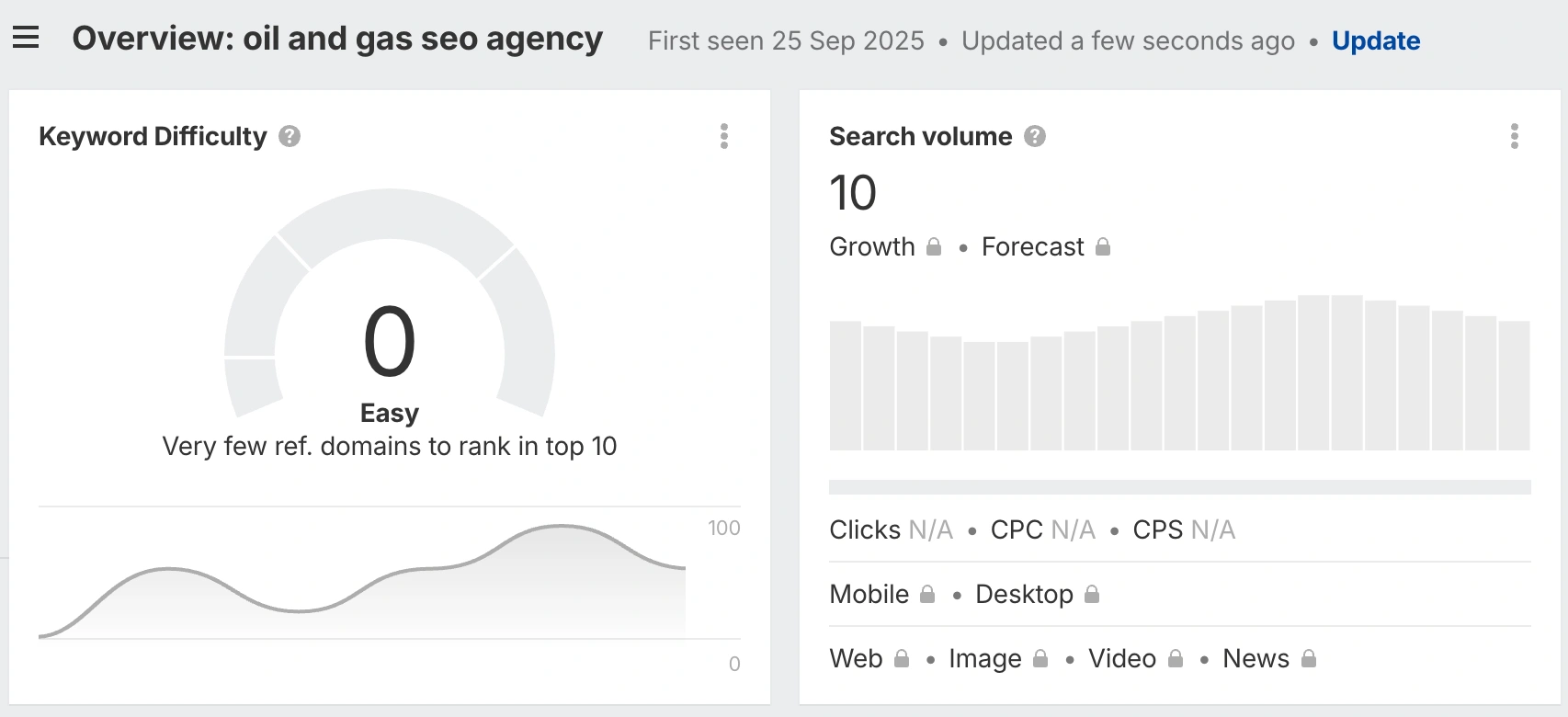
That’s why SEO tools may not show any volume for them at all. It doesn’t mean nobody is searching for them. It usually means the search is too narrow, too long-tail, or too uncommon to appear properly in those databases.
However, such keywords often come from people who already know what they need, are much closer to a buying decision, and are searching in very specific language. So while the traffic may look small, the business value can be much higher.
For example, in a B2B SaaS SEO campaign, a broad keyword like “project management software” may look attractive because it has search volume, but it is also extremely competitive and often too wide in intent.
A zero-volume keyword like “project management software for pharma compliance teams” may show nothing in SEO tools, but if that page gets one or two highly relevant demo requests from the right type of company, the ROI can be much stronger.
In that kind of case, the so-called zero-volume keyword can easily be ten times more valuable than the bigger keyword everyone else is targeting.
Track ROI by Page Type
In our agency, we also keep a close eye on analytics. But get ready, because I’m about to give you a $1M piece of advice. In GA4, or maybe in a third-party analytics tool, you can track which pages drive the most leads.
For example, if you’re running a B2B eCommerce SEO campaign, it makes sense to track which collection pages or product pages drive the most revenue.
But what’s even more interesting is that you can then double down on the pages that already work, whether those are blog posts, landing pages, or something else. And by “work,” I mean pages that generate leads and revenue.
Here’s another example. Let’s say you have a blog post called “B2B SEO audit checklist,” and over time, you notice that it keeps bringing in leads. That’s a sign you should create more content like that, because it’s clearly doing its job.
Do you see where I’m coming from? Crazy, isn’t it?
Is SEO Worth It for B2B Companies?
Yes, absolutely, SEO is worth it for B2B companies. Your buyers are already searching. They are comparing vendors, looking for solutions, checking specific problems, reading industry content, and trying to understand who they can trust.
If your company appears during those moments, SEO can bring you highly relevant traffic, qualified leads, and a pipeline that keeps growing over time.
Is SEO Better Than Paid Ads for B2B ROI?
Yes, in many cases, SEO delivers better ROI for B2Bs than paid ads, but the tradeoff is speed. Paid ads usually work faster. SEO usually takes longer, but once it starts working, the return often becomes much stronger over time.
If you want faster leads, paid ads usually win in the short term. If you want stronger long-term ROI, SEO usually wins.
Written by
Ashot NanayanSEO Strategist
Ashot Nanayan is an SEO strategist and the founder of B2BSEO.io. He helps B2B companies build search systems that do more than rank pages. His approach connects Google visibility, AI search presence, content depth, authority, and buyer intent, so brands appear where serious decisions start.