B2B SaaS SEO 101: A Practical Guide to Pipeline-Driven SEO

Ashot Nanayan
SEO Strategist
Table of content
I get shocked whenever I see so-called experts recycle the same general SEO advice into “best B2B SEO” guides and strategies, then say, “Based on my experience,” while you can clearly see the same writer also talks about healthcare, finance, and everything else somewhere else.
The worst part is that search engines, especially Google, still rank such content in the top 10 just because the website has authority at some point (Yeah, Google still isn’t ideal).
So, I’m writing this guide based on my seven years of experience in SaaS SEO, managing dozens of campaigns, handling $50K to $100K monthly budgets, and working with companies such as CapCut, HubSpot, and many others.
In this guide, I’m going to share my experience as a freelancer and a specialized B2B SEO agency owner, with high hopes that it will rank in the top three so you can find it, apply these insights to your own projects, and maybe even thank me for giving all of this away for free.
Ready to grow smarter?
Book a free 30-minute strategy call with our team. We'll audit your search visibility and build a custom action plan.
What Is B2B SaaS SEO?
B2B SaaS SEO is the process of getting your software in front of the right people when they search for the problems your product solves, the solutions they are comparing, or the terms they use before they book a demo or talk to sales.
Of course, SEO is still SEO. The difference is in the buying journey. In B2B SaaS, people usually do not search once and convert right away. They compare tools, read use cases, check integrations, look for alternatives, involve other team members, and often take weeks or months before making a decision.
B2B SaaS SEO vs. General SEO
The core SEO principles do not suddenly change just because a company sells software to other businesses. You still need solid technical SEO, strong content, proper internal linking, relevant backlinks, and pages that deserve to rank. In that sense, B2B SaaS SEO is not some completely separate discipline.
The difference is what you are trying to make SEO do. With general SEO, the goal is often broader. You may want traffic, visibility, brand awareness, affiliate clicks, ad revenue, local leads, or direct online sales.
B2B SaaS SEO is much narrower and much more demanding. You are usually targeting a smaller audience, harder keywords, longer buying cycles, and people who rarely convert on the first visit.
In B2B SaaS, SEO has to do more than attract visitors. It has to educate, qualify, build trust, support comparisons, and help move the right people closer to a demo, a trial, or a sales conversation.
So while general SEO can sometimes win by bringing in large volumes of traffic, B2B SaaS SEO often wins by bringing in the right traffic, even if the numbers look smaller on paper.
Priority
Reduce signup friction
Improve pipeline quality
AI Visibility
Brand mentions, reviews, app comparisons
Listicles, category pages, expert mentions, vendor comparisons
Tracking
Signups, trials, upgrades, churn signals
MQLs, SQLs, demos, pipeline, CAC, revenue influence
Trust Signals
Reviews, ratings, testimonials, app-store proof
Case studies, security pages, compliance, logos, analyst mentions
Content Gaps
How-to guides, templates, comparisons, alternatives
BOFU pages, ROI content, integration pages, sales enablement assets
The Importance of SEO for B2B SaaS
SEO is very important in B2B SaaS because in most cases, your buyer does not wake up, search once, visit your site, and book a demo in five minutes. SEO is one of the main ways serious buyers discover you, evaluate you, and quietly decide whether you are worth shortlisting.
If you are not visible when they search for the problem, the solution type, the comparison term, or the alternative they are considering, you are often out of the race before you even know there was a race.
By the way, you can also read my detailed guide on B2B SEO.
18 B2B SaaS SEO Strategies from an Agency Owner
Below, I’m going to share 18 unique and proven B2B SaaS SEO strategies we’ve personally tested with our B2B SaaS SEO agency across real campaigns.
Instead of filling this section with the same generic advice you see everywhere else, I want to give you more specifics, more context, and more practical detail so you can take something useful from each point.
1. Build Dedicated Pages for Every Core Use Case
I wanted to start with this one for a reason. If you are serious about B2B SaaS SEO, this is one of the first strategies you should prioritize from day one.
A lot of B2B SaaS companies put too much pressure on their homepage, product page, or a few blog posts, and expect those pages to rank for everything.
But what if your product solves multiple problems for different teams, industries, or workflows?
Search intent is rarely that broad. People do not always search for your software category only. In many cases, they search for a very specific use case tied to what they are trying to solve.
Famous brands like Asana already know that. See what I mean?
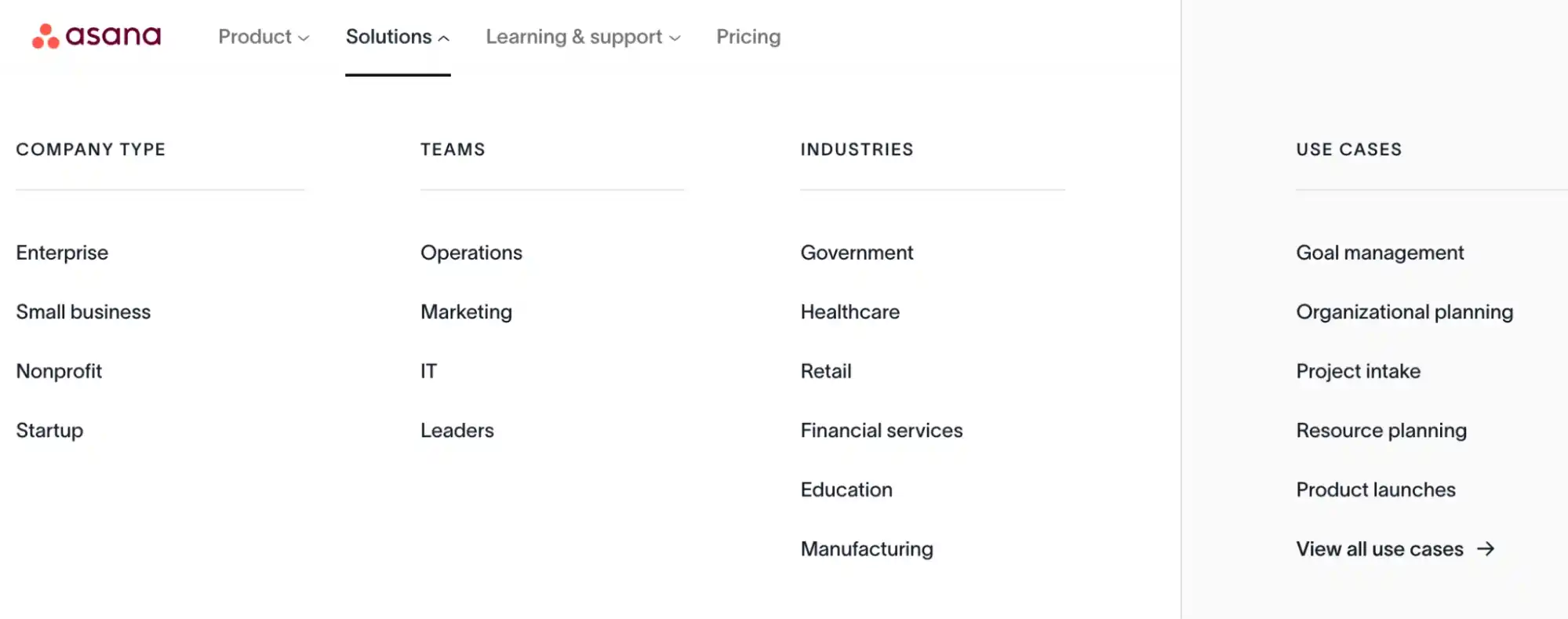
Yeah, a good example is a company like Asana. They do not just talk about project management in general. They build pages around specific use cases, workflows, and team needs.
Use cases let you create focused pages around real problems, workflows, and business needs your product helps with.
Instead of speaking to everyone at once, you can speak directly to a specific type of buyer or a specific problem they are trying to fix.
When building use case pages, I would look at a few things. First, what are the main reasons people buy your product in the first place? Second, what are the most common workflows, pain points, or recurring jobs your product helps with?
Third, how do different teams describe those needs in search? A marketing team, an operations lead, and a founder may be solving a similar problem, but they often search for it differently.
Pro Insights
A very practical tip here is this: don’t build use case pages as thin SEO landing pages with a slightly changed headline and the same copy repeated 20 times.
That is one of the fastest ways to create weak pages that don’t rank and don’t convert. Each page should feel like it was built for that exact use case, with its own pain points, workflows, features, examples, and objections.
2. Create Landing Pages for the Industries You Want to Win
This is very similar to the use case page strategy I mentioned earlier, but here I’m talking specifically about industry pages. Industry pages let you target high-intent long-tail searches that are much closer to the way buyers look for software.
Instead of relying only on a broad page like “CRM software,” you can create focused pages around terms like “CRM software for accountants,” “CRM software for manufacturers,” or “CRM software for small businesses.”
Here is Slack’s example:
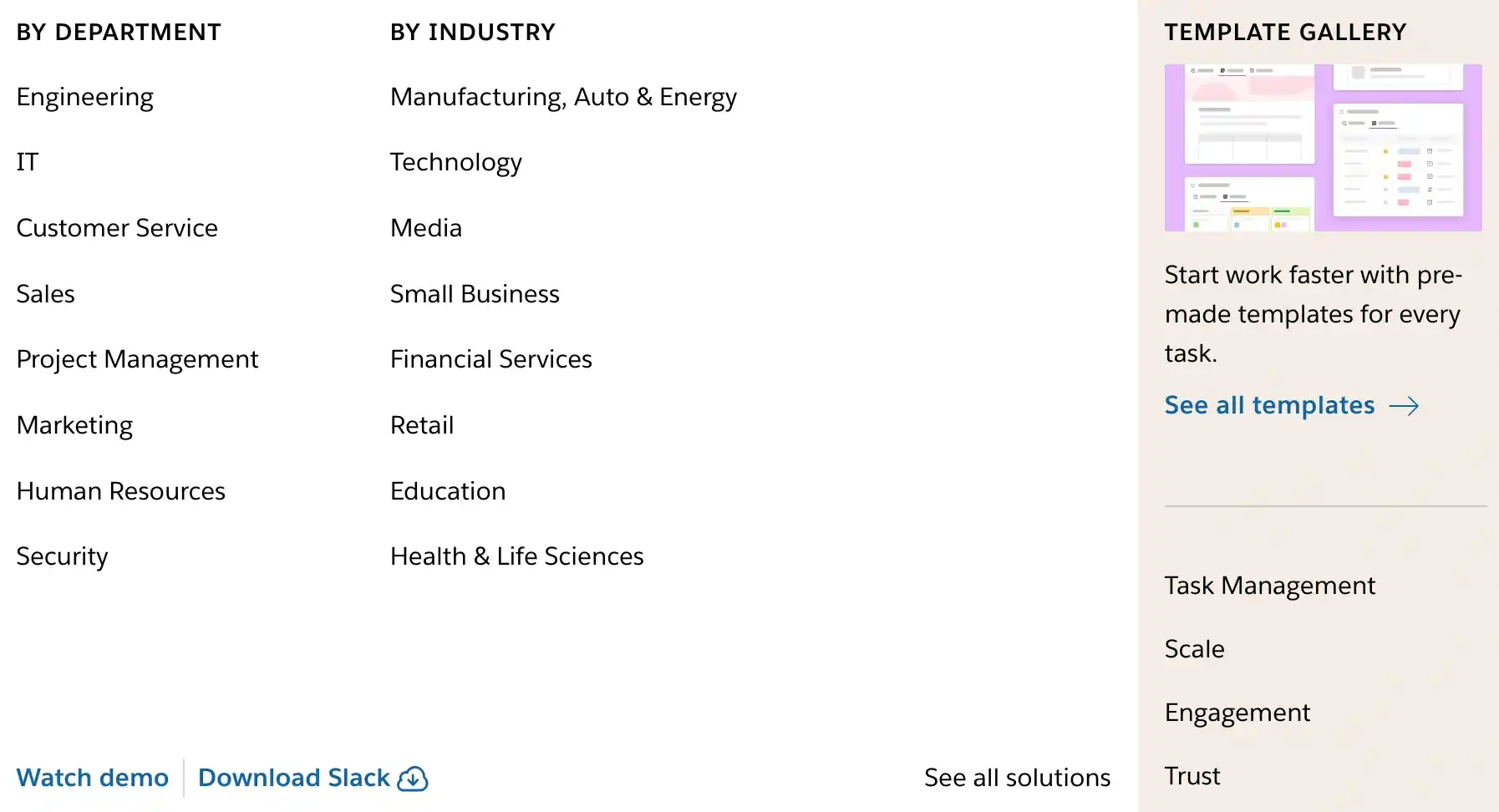
Those searches are usually more specific, more qualified, and often much closer to conversion.
However, many SaaS companies create industry pages just because the keywords have search volume, not because they offer something unique or meaningful to an X industry.
Google has long warned against doorway-style pages built mainly for search engines, and its spam policies also call out scaled content created primarily to manipulate rankings rather than help users.
So before you even start B2B keyword research for industry pages, make sure your product has something to offer those industries.
3. Turn Your Help Center and Docs Into a Traffic Channel
I do not want to jump too far ahead, but one of the best examples of this is Ahrefs itself. If you look at their Help Center, you’ll figure out what I mean.
They get more than 100k traffic/month from their health center alone. Do you know why?
Because they did not limit those topics to a forum or a basic comment section.
Instead, their team took the time to understand what users keep asking, what prospects keep searching, and what problems come up again and again, then turned those questions into evergreen content like this one (And grouped them).
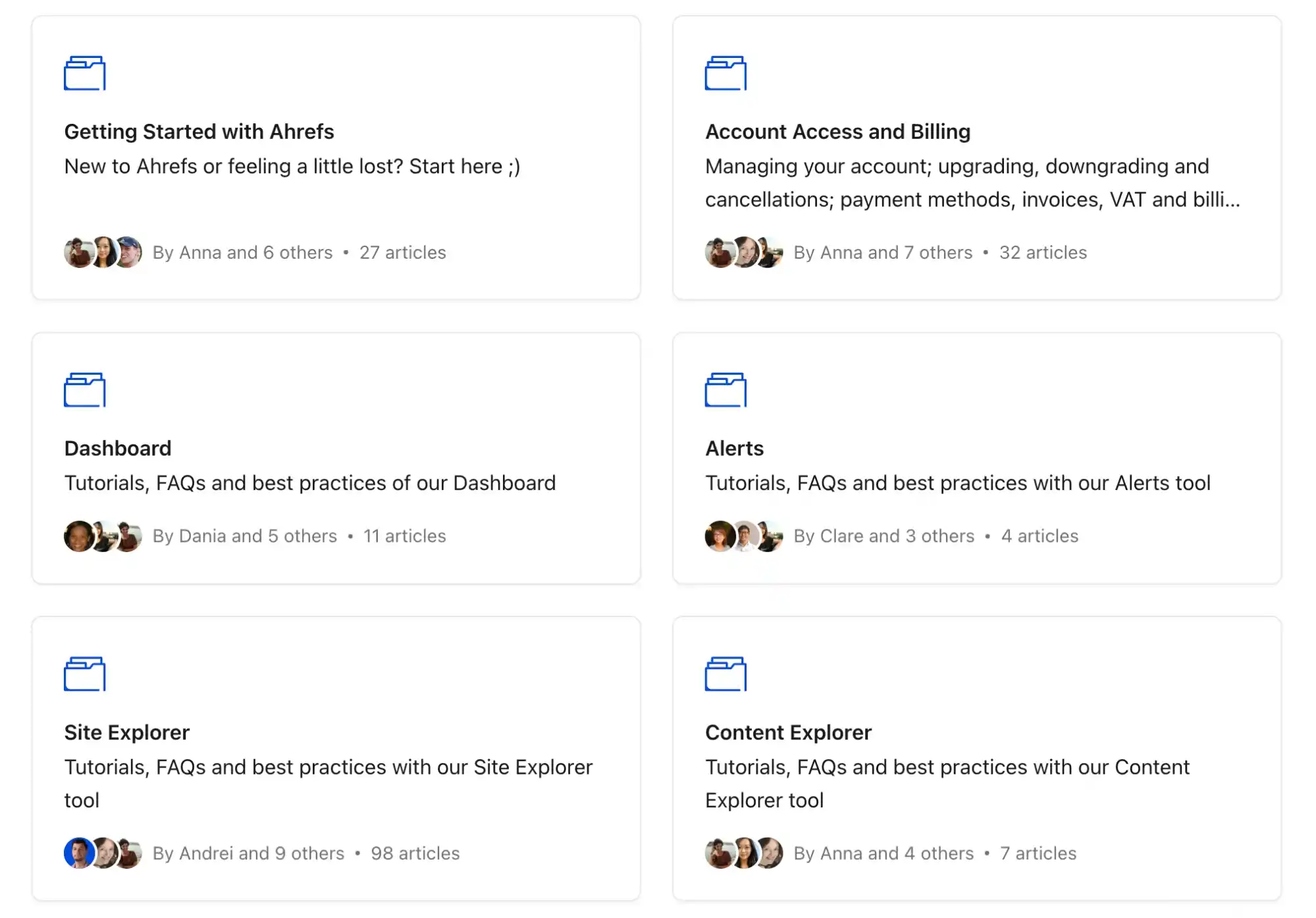
A lot of B2B SaaS companies ignore their docs, FAQs, and support content from an SEO point of view. They manage them as purely operational pages, while in reality, many of those topics have enough search demand, especially when users are trying to solve product-specific problems, compare workflows, understand features, or troubleshoot issues.
If you do not build such content properly, your competitors will take advantage of it.
I would not put this at the top of the list for early-stage startups or brand-new SaaS sites. In most cases, this works better once you are a bit further into your journey, when you already have enough customers, enough questions, enough use cases, and enough product depth to build this section the right way.
4. Launch Templates, Calculators, and Free Tools
These are assets you should not ignore if you want direct and indirect SEO benefits. One of the good things about the SaaS space is that it gives you a lot of room to research and create assets like these.
If you have the chance, I would definitely look at the programmatic side too.
This is especially useful for templates and similar asset types, where you can create many pages at scale without needing huge resources.
Sometimes, a smart setup, a developer, and the right system are enough to publish a large number of useful pages much faster than most SaaS companies expect.
Why Free Tools Build Better B2B SEO Assets
Free calculators, templates, checkers, and simple tools help B2B buyers solve small problems first, while making your brand easier to discover, cite, and trust.
-
1
Earn natural links
Useful tools attract backlinks without begging for them. A calculator, template, checklist, or estimator gives other websites a real reason to reference your page.
-
2
Capture high-intent visitors
People using calculators and tools usually have an active problem. That makes the traffic more valuable than visitors who are only reading general blog content.
-
3
Improve AI visibility
AI tools often look for clear, useful, reference-worthy assets when answering practical questions. A strong free tool can help your brand become part of those answers.
-
4
Support BOFU content
Tools can connect directly to buying decisions. Pricing calculators, ROI calculators, savings estimators, product selectors, and comparison tools can move visitors closer to a demo, quote, or purchase.
-
5
Create reusable lead magnets
A good tool can work across SEO, paid ads, email, LinkedIn, sales outreach, and retargeting. Instead of promoting another generic blog post, your team has something genuinely useful to share.
5. Create Linkable Assets
You have dozens, and in some cases even hundreds, of opportunities to create strong linkable assets. The problem is that many brands either do not invest in them at all or create the wrong type of assets and then wonder why nobody links to them.
I do not want to give you the usual lazy advice like “just test different formats and see what works.” In our team, we have already tested a lot of things, and I can confidently say that some formats consistently perform better than others when it comes to earning backlinks naturally.
Below, I’m going to list the linkable asset types I like most, based on their potential to earn backlinks.
Of course, not every asset will be a success, and yes, sometimes you will invest time and resources into something that does not perform as well as you expected.
But overall, this is one of the smartest long-term plays you can make.
Remember, you cannot spend your entire SEO journey building backlinks manually forever. At some point, your site also needs assets that earn links on their own.
So if you are hiring a B2B SEO agency, make sure they know how to create strong linkable assets, not just build links to whatever pages already exist.
6. Strengthen Your Google E.E.A.T. Signals
In very simple words, Google E-E-A-T is Google’s way of asking, “Why should I trust this website and the people behind this content?” It stands for Experience, Expertise, Authoritativeness, and Trustworthiness.
Google added the extra “E” for experience to make it clearer that first-hand knowledge is very important too, not just formal expertise.
Google also says its raters use these ideas to evaluate content quality, and that creators can use the same framework to assess their own pages.
For SaaS websites, I would focus on the following factors to strengthen overall Google E-E-A-T, which is also a smart move for AI search and AI-driven answers because those systems also rely on content that feels original, trustworthy, and useful.
Google E-E-A-T Factors by Impact
A simple breakdown of the trust signals that matter most when Google and buyers judge whether your content deserves attention.
Author / Expert Profile
30
Brand Reputation
30
Content Accuracy & Helpfulness
25
Backlinks
15
To be honest, I still see many websites and pages ranking well without any obvious E-E-A-T optimization. But that’s just how it is sometimes. What we can do is make sure we’re not leaving any stone unturned on our side.
7. Invest in BOFU Content That Can Drive Pipeline
AI Overviews and everything happening in search right now have changed SEO a lot. Based on our latest reports, tests, and experiments, I can clearly see that ranking in the top three to five positions does not always mean what it used to mean.
In many cases, you can still rank well organically and get very few clicks, or see CTR numbers that are much lower than they should be.
A big reason is that a lot of TOFU content is not as powerful as it once was, especially the usual “what is this” and “what is that” type of articles.
I am not saying those topics are completely useless, but if your goal is to generate B2B leads from SEO, they should not be the center of your strategy anymore.
It’s time to prioritize BOFU content that brings you much closer to actual buying intent. In many cases, BOFU content puts you several steps ahead of competitors that are still busy targeting broad traffic with low commercial value.
Below, I’m going to list the best BOFU content types based on how likely they are to convert.
asddd
If you want SEO to generate leads, this is one of the most essential parts of the whole strategy. I would even say that if you have a limited budget and want faster wins before thinking too much about long-term traffic growth, your B2B SEO content strategy should be developed around BOFU opportunities first.
Yes, your blog can still work for you.
But today, it has to work harder and smarter, which usually starts by publishing content that supports decisions, not just curiosity.
8. Build Niche-Specific Content Hubs
Before we get into this, if you want a clearer idea of what a content hub strategy looks like, you can watch this YouTube video. It will give you a full picture.
Content Hubs: Where SEO and Content Marketing Meet
Now, back to my point. Content hubs are one of my favorite content strategies, and they work very well across many industries, including B2B SaaS.
I still remember a short consultation call I had with one of the SEO experts at InVideo. He said something I never forgot: be the big fish in a small pool.
That one sentence stayed with me, and honestly, it helped shape a lot of SEO strategies that later turned into successful projects.
What do I mean by that in B2B SaaS?
Do not try to publish about everything. Do not pick random topics just because they have search volume.
For example, if your product is closely connected to workplace productivity, then build your content strategy around one topic and cover it from every possible angle.
Sometimes I would even cover topics regardless of search volume if I knew they would help complete the picture and make the hub stronger.
So my advice: stay close to your product, and try to become one of the strongest resources in that small corner first. In many cases, that works much better than trying to be everywhere at once.
9. Run HARO Campaigns
If you have been in SEO for at least some time, I’m sure you already know the usual link-building techniques like guest posting, ABC exchanges, and similar tactics.
They still exist, and yes, they still have their place. But if you want to earn the links and brand mentions that are much harder to get and much stronger for long-term authority, HARO-style campaigns are something you should seriously look at.
Definition
If you want to earn links that money often cannot buy directly, this is one of the smartest strategies in SaaS. You can either outsource it to a team that knows how to do it properly or you can handle it in-house by subscribing to relevant platforms and replying to opportunities consistently.
By the way, B2BSEO.io provides HARO-link-building services. We’ll help you secure links that money can not buy.
Personally, I have earned links this way from websites like Shopify, Zapier, and similar high-authority publications without paying for the placement itself.
That’s why I like this strategy so much.
10. Optimize Your Site for AI Search Visibility
Google is still the number one search engine by a huge margin. Statcounter’s March 2026 data puts Google at about 89.85% of the worldwide search market share. But at the same time, more and more people, including B2B buyers, are turning to LLMs, especially ChatGPT, to discover tools, compare companies, and find trusted recommendations.
OpenAI has said ChatGPT now reaches hundreds of millions of weekly active users, and recent OpenAI updates have continued to position it as the clear consumer leader in AI.
So yes, if you are not thinking about AI search visibility, you are missing something, believe me.
However, this is also where many experts and B2B SEO agencies get confused.
They talk about AI search optimization as if it were some completely different game. I still believe the same thing I have been saying again and again: AI SEO is still SEO.
What changes is how your content gets discovered, summarized, and recommended. AI search engines are much more likely to surface websites that are easy to understand, well-structured, trustworthy, and backed by real signals across the web.
Below, I’m going to share some of the best practices I recommend for B2B SaaS websites that want stronger visibility in AI search engines, too.
-
1
Own comparison intent
Create strong alternative, competitor comparison, and “best software for X” pages. AI tools often answer SaaS questions by comparing categories, features, use cases, pricing, and positioning.
-
2
Build use-case depth
Don’t describe your product only by features. Create pages for industries, teams, workflows, pain points, integrations, and specific business outcomes so AI tools can understand when your product is the right fit.
-
3
Strengthen third-party mentions
Get listed on software directories, review sites, niche listicles, partner pages, podcasts, and industry publications. AI tools trust brands that are mentioned consistently outside their own website.
-
4
Publish proof-heavy content
Case studies, customer stories, benchmarks, ROI pages, migration stories, and product-led examples make your brand easier to verify. For B2B SaaS, AI visibility depends heavily on trust, not just content volume.
-
5
Optimize for integration searches
Many SaaS buyers search around tools they already use. Build pages for “your software + HubSpot,” “your software + Salesforce,” “your software + Slack,” and similar integration-driven queries.
-
6
Make pricing and positioning clear
AI tools struggle when your offer is unclear. Clear pricing context, ideal customer profiles, feature differences, plan comparisons, and “who it’s for” sections help your brand appear in more accurate recommendations.
By the way, if you want something much more detailed, you can also read my other guide on how to audit your website for LLM visibility.
11. Track SEO by Signups, Demos, SQLs, and Revenue Impact
Most B2B SEO reports look the same: organic traffic, keyword rankings, and maybe some screenshots from Search Console. Then the usual “work completed,” “work planned,” and stuff like that.
I am not saying those reports are not important. Of course, they are. But in B2B SaaS, it is not enough. If you want to understand whether your SEO is working, you need to track the metrics that are closer to the pipeline and revenue, not just visibility.
I am talking about signups, demo requests, SQLs, influenced deals, and actual revenue impact.
So yes, this may not sound like a traditional B2B SaaS SEO strategy. It is more of a discipline, or maybe a reporting mindset. But I still think it is too important not to mention.
I would feel wrong leaving this out (Lol).
Here are some FAQs I’m sure you’re going to look for after reading this section:
Common FAQs
12. Use Programmatic SEO Where It Makes Sense
It is not by chance that I am saying where it makes sense. Personally, I am not a huge fan of programmatic SEO, especially when companies scale pages blindly without thinking about intent, competition, market demand, or whether those pages deserve to exist.
Don’t get me wrong, programmatic SEO is still one of the strongest strategies for SaaS. Some of the best-known examples are companies like Canva and Zapier, which have built large-scale page sets around use cases, integrations, templates, and other search patterns that match what people want.
The strategy works. The problem is that many teams copy the format without understanding why it works.
Personally, when our team runs programmatic SEO campaigns for SaaS companies, the first thing we care about is the uniqueness of the landing pages.
We do not just automate everything and hope Google figures it out.
Pro Tip
Common FAQs that our clients always ask:
Should you publish hundreds of pages at once?
No, my friend. First test, like maybe 20-30 pages, and give it some time to see how they perform (E.g., Google might deindex bulk published pages). Then, in some time, if they’re performing as expected, scale it.
Should you submit them to bulk indexing through the Google API?
No, it’s risky.
Should you automate the internal linking?
It’s better to organize internal linking with a good UX, not automated tools (They don’t even work as expected).
13. Localize Your Software (First Test with Google Ads)
We all know how tough the English market is. In many SaaS niches, the competition is high, and sometimes even if your SEO strategy is good, your B2B SEO ROI does not look as strong as it should, just because you are fighting in a very crowded space with a limited budget.
In many cases, we recommend scaling into other languages when the product and the business model allow it. Markets like Spanish, Portuguese, German, and many others can sometimes offer much lower SEO competition while still giving you access to a very strong audience.
The good thing today is that localization is much easier to execute than it was a few years ago. You can automate a big part of the process, move faster, and expand your reach without needing massive resources.
Pro tip: Test the language opportunity with Google Ads first.
Before you invest in localizing product pages, landing pages, or your content strategy, run paid campaigns, test demand, look at lead quality, and see whether the market matches your expectations.
Luckily, I also have a detailed guide on international SEO for B2Bs; you can start investigating today.
14. Improve Crawl Budget and Tighten Up Technical SEO
I do not want to start this section with the usual advice like “optimize your technical SEO” or “make sure your robots.txt and XML sitemaps are in place.” Of course, you should do that, but this guide is not about repeating general SEO advice. We are talking about B2B SaaS SEO.
In SaaS, one issue I see very often is crawl budget waste. This becomes even more common when a company starts scaling fast, localizing its software, building out help centers, creating docs, templates, integration pages, or other large groups of pages without thinking enough about crawl efficiency.
In simple words, one of my goals is always to make sure Google and other search engines can crawl the pages that matter without wasting too much time and resources on pages that do not.
Crawl budget optimization is always in my B2B SEO audit checklist. I highly recommend checking Google Search Console closely and understanding what Google is crawling, indexing, and prioritizing.
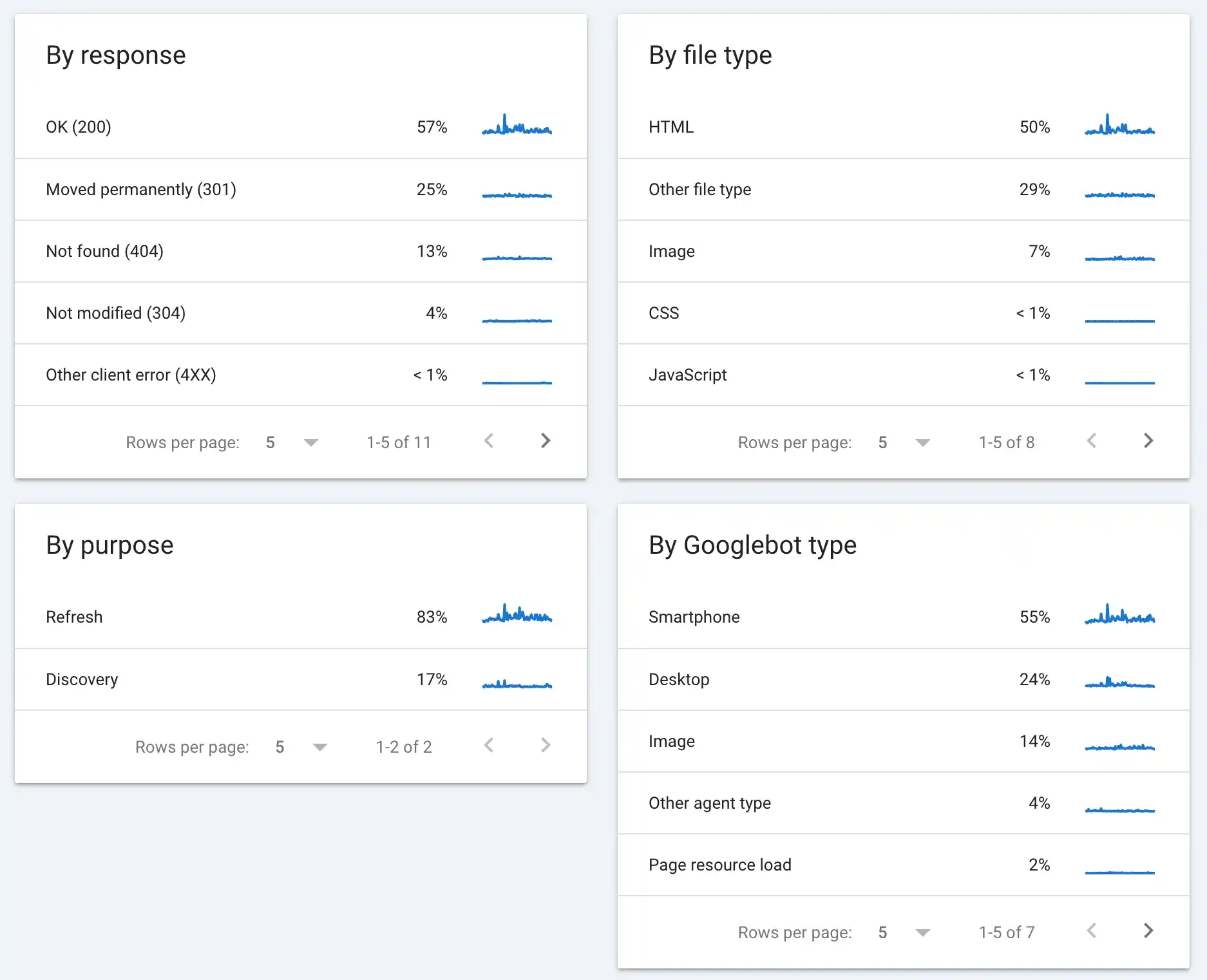
Look at which pages are being discovered, which ones are being ignored, whether your key pages are healthy, whether mobile rendering is solid, and whether Google is reaching your main HTML content properly.
A lot of SaaS companies assume things are fine just because the site is live, while in reality, search engines may be spending energy in the wrong places.
This is a more advanced area, and honestly, it is one of those parts of SEO where I would rather work with someone who really knows what they are doing than guess my way through it.
15. Use Schema Markup
Schema markup, also known as structured data, is a great way to improve your overall search visibility and, in many cases, your CTR as well.
In very simple words, schema markup is extra code you add to your pages to help search engines understand the content better. It tells Google what a page is about in a more structured way.
For example, whether a page is about your company, your product, a review, an FAQ, an article, or something else. It does not guarantee higher rankings, but it can help search engines process your content more clearly and sometimes improve how your pages appear in search.
I know this is not really a “strategy” in the usual sense. It is more like something you should already be doing if you want your SaaS website to be as clear and search-friendly as possible.
For SaaS businesses, I would say some of the most important schema types are Organization, WebSite, SoftwareApplication, Product, Review, FAQPage when appropriate, Article for blog content, and in some cases BreadcrumbList as well.
16. Work with the CEO to Catch Industry Trends Early
As an SEO expert, I know SEO and all the SEO trends that come and go. However, that is not enough. The CEO or founder usually knows the market better than anyone else. They are much closer to the product, the customer conversations, the shifts in demand, and the trends that are just about to happen. So when you combine your SEO skills with their market vision, that is where things can get very interesting.
Let me give you an example. A couple of years ago, I was working with a B2C SaaS company in the AI video generator space, and the founder, Michael, taught me a lot about how fast that industry was moving.
He was following AI trends very closely, and in many cases, he could already see where the market was heading before the search volume even appeared in the SEO tools.
That was a big lesson for me. My SEO skills alone were not enough there. The tools showed nothing, but the founder could already tell me which features, trends, and use cases were about to matter.
So we started creating content around those topics earlier, sometimes months before they became competitive or even visible in SEO tools.
So, sometimes the best SEO opportunities do not come from Ahrefs, SEMrush, or any keyword tool, but from the founder who lives inside that industry every day and can spot where things are going before the rest of the market catches up.
17. Build a Stronger Brand Reputation Across the Web
A lot of clients come in with the same mindset: let’s do SEO, and the way they think about it is often very narrow. They assume Google ranks pages mostly because of content and backlinks, and once those two pieces are in place, the rest will somehow take care of itself.
Of course, content and links are important. Nobody can argue with that. But in my opinion, Google ranks brands, not just websites.
If you are in a competitive niche, and most SaaS companies are, then working only on your website is usually not enough.
You should also invest in your broader business and brand reputation. I am talking about things like digital PR, brand mentions, social media presence, product reviews, podcast appearances, YouTube visibility, forum participation, community engagement, and a lot more.
They make your company look more real, more talked about, more trusted, and more established.
Yes, this guide is primarily about SEO. But I would be doing you a disservice if I pretended SEO works alone. Especially in SaaS, if you want stronger long-term results, do not just focus on building rankings. Build a brand people recognize, mention, trust, and search for.
18. Keep a Close Eye on Competitors
I want to close this section with another very important point. It is not by chance that I am including this as one of the B2B SaaS SEO strategies.
A lot of companies still think that competitor analysis is something you should do every three to six months. Well, in some industries that may be enough, but SaaS?
In SaaS, things can change very fast. You can wake up one day and see that a competitor has launched dozens of new landing pages or blog content.
No, my friend; every day.
In our agency, for example, we sometimes dedicate specific people just to monitor competitors on a daily or weekly basis, depending on how competitive the niche is. We also automate a big part of the process to track things like new backlinks, keywords, fresh content, new landing pages, and overall SEO performance.
B2B SaaS SEO Through the Eyes of Industry Experts
Jenn Mathews – Her B2B SaaS view is that SEO should be mapped to the customer journey, not just keyword volume. In her Search Engine Land piece, she says B2B SaaS SEO works better when content is aligned to the buyer experience across stages, because SaaS deals depend on helping people make informed decisions, not just attracting visits.
That is a very different mindset from publishing random TOFU posts.
Thenuka Karunaratne – In an Animalz interview, he explains a very SaaS-specific approach: start with the ICP first, then work backward into the long-tail search patterns that person is likely to have.
His example was a cybersecurity SaaS company where the team used the target buyer profile first, then built SEO around searches tied to data breaches and vulnerabilities.
The takeaway is sharp: in B2B SaaS, keyword research should begin with the buyer’s real problems, not a giant keyword export.
Kevin Indig – One of the clearest recent insights for SaaS is his point that “SEO should not just be on Google anymore.” He notes that AI Overviews can source citations from places like YouTube or LinkedIn, which means a SaaS brand trying to win visibility may need to think beyond its blog.
For B2B SaaS, that matters because buyers already research across multiple surfaces before they ever request a demo.
Amanda Natividad – Her most relevant insight for SaaS is that the old “find high-volume, low-competition keywords” playbook is fading. She argues that modern SEO is more audience-first: figure out where your audience spends time and fit your marketing into those conversations.
For B2B SaaS, that means SEO can no longer live in a silo; it has to connect with communities, branded demand, social distribution, and zero-click discovery.
Eli Schwartz – His recent take is especially relevant for SaaS brands trying to adapt to AI search: focus on answer optimization, not algorithm gaming. He warns that chasing GEO-style manipulation can repeat old SEO mistakes, and says the durable path is actionable, data-backed content, trusted SMEs, and earned authority.
For B2B SaaS, that usually means stronger expert-led product education, better use-case pages, and more credible off-page authority.
Gaetano Nino DiNardi – Two of his ideas stand out. First, he argues SaaS teams need to stop chasing traffic for its own sake and focus on business value.
Second, he says that if a software company wants to be visible in AI search results and recommendations, it needs more links and mentions.
That is very specific to B2B SaaS because many SaaS teams still overinvest in content production while underinvesting in brand mentions, digital PR, HARO, and authoritative citations.
How to Choose Target Keywords for B2B SaaS
First of all, if you are looking for a full B2B keyword research guide, I already have another detailed article you can check out. But in this article, I want to focus less on keyword research techniques and more on how to choose the right targets in practice.
There is no one-size-fits-all answer here. A lot depends on your situation. Are you a new B2B SaaS company or an established one? Are you working with a small budget or a serious one?
What market are you targeting? How strong is your current SEO foundation? Finally, how competitive is your niche overall? All of these factors can change which keywords make sense to go after first.
I mean, there are still a few key things I believe you should always take into account if you want to target the right B2B SaaS keywords and get the most out of your SEO efforts.
-
1
Start with product-led intent
Don’t begin with broad SaaS keywords. Start with the problems your product solves, the workflows it improves, the tools it replaces, and the exact use cases buyers care about.
-
2
Separate users from buyers
In B2B SaaS, the person searching may not be the final decision-maker. Group keywords by end-user pain points, team-level needs, executive concerns, and procurement-stage questions.
-
3
Prioritize BOFU modifiers
Look for keywords with terms like “best,” “alternative,” “comparison,” “pricing,” “software,” “platform,” “tools,” “for [industry],” and “vs.” These usually sit closer to demos, trials, and buying decisions.
-
4
Map keywords to funnel pages
Every valuable keyword should have a job. Some belong on feature pages, some on use-case pages, some on comparison pages, and some on educational content that supports the buyer journey.
The Cost of SaaS SEO
A realistic working range for SaaS SEO is around $5,000 to $10,000 per month when you include the bigger picture, not just the agency or consultant fee.
I am talking about everything, including service costs, content development, link- building, and overall authority building.
Based on our data working with dozens of SaaS brands, I would say on average, $5,000 to $7,000 per month is the starting point if a company wants to see positive results in a reasonable timeframe.
Recent industry data puts common hourly rates around $75 to $100 per hour for many agencies and freelancers, while consultants often sit closer to $100 to $150 per hour.
Average ROI from SEO for B2B SaaS
There is some interesting data, but I want to be honest: truly strong, public, B2B SaaS–only SEO ROI data is still pretty limited. Most of the specific numbers come from agency benchmark reports rather than massive neutral industry datasets.
However, I could find some interesting stuff (I can not guarantee it’s true, but it’s near what we get for our clients).
A practical benchmark comes from First Page Sage’s SEO ROI report, which estimates B2B SaaS SEO at roughly 702% average ROI over three years, with an estimated 7-month break-even point and about 8.75x ROAS.
average ROI over three years
In a separate B2B SaaS KPI report, the same firm puts SEO campaign ROI for B2B SaaS at 748%, far above its reported benchmark for PPC at 36%.
Need some estimates? Use our SEO ROI calculator.
ertetete4t
Projected Results
Projected Traffic
Monthly Leads
Additional Revenue
Estimated ROI
+5733%
based on 2.4× traffic multiplier
Projections based on industry averages. Actual results vary by niche, competition, and execution quality.
How Long Does SaaS SEO Take?
Based on our own experience working with 50+ SaaS brands, newly launched websites or startups with limited budgets usually need around 8 to 16 months to see tangible SEO results. For more established brands that already have some foundation and want to grow their existing traffic, visibility, and overall authority, the timeline is often closer to 6 to 8 months.
Of course, these are still just estimates, not guarantees. SEO timelines can change a lot depending on your budget, competition level, current SEO health, internal resources, speed of execution, and how strong your strategy is from the start.
B2B SaaS SEO for Startups: What to Focus on First
If I had a B2B SaaS startup today, I would not try to do everything at once. I would focus on the foundations first (On-page SEO, technicals, landing pages, UX, etc), then build enough content to create relevance, and after that, I would shift a lot of my attention toward authority.
Here is what my process would look like:
B2B SaaS SEO Roadmap for Startups
A proven SEO growth plan for early-stage B2B SaaS teams
Market & Search Opportunity Audit
Find the keywords, competitors, use cases, pain points, and product categories where your startup can realistically win.
Fast-win SEO opportunities mappedPositioning-Led Keyword Strategy
Connect keywords to your ICP, product value, buyer problems, and sales funnel instead of chasing random search volume.
Keywords grouped by funnel stageCore Website & Product Pages
Build or improve your homepage, feature pages, use-case pages, comparison pages, and pricing-related content for better conversion.
Money pages prioritizedBOFU Content Engine
Create content around alternatives, comparisons, integrations, templates, pain points, and “best software for” searches.
Decision-stage topics plannedAuthority & Demand Compounding
Earn relevant SaaS links, appear in listicles, strengthen brand mentions, and measure SEO by demos, trials, signups, and pipeline.
SEO tied to startup growthNext, I would publish around 15 to 20 very strong, expert-first, human-first content pieces to build topical relevance, support internal linking, and give Google enough context around the niche, the product, and the problems the software solves.
After that, instead of wasting too much time and budget on publishing endless content, I would focus on authority building.
At the same time, I would subscribe to platforms like Qwoted and Help a b2bwriters.com and start working on earning high-quality backlinks through expert contributions and media opportunities.
Then I would give it some time. I would analyze impressions, clicks, rankings, indexed pages, and overall performance for a few months, then decide how to scale based on what the data is showing me.
The Bottom Line
In this guide on B2B SaaS SEO, I shared the strategies, best practices, tips, and cost estimates I believe matter most if you want to grow through SEO thoughtfully.
As you see, I did not write this to repeat the same generic advice you see in every other article. I wrote it based on my own experience as a freelancer and agency owner, working with many SaaS clients across different budgets and growth stages.
So if you are looking for an honest, reliable, and specialized B2B SaaS SEO agency that can help take your growth to the next level without cheap tactics, fake guarantees, or stuff that hurts you later, contact us today, and let’s have a real conversation.
Why Do Some SaaS Sites Get Traffic but Not Demos?
One of the biggest reasons is when companies celebrate traffic growth too early, while demo requests stay flat.
The first reason is that the traffic is not qualified. You may be attracting people, but not the ones who are likely to buy your product.
But let’s say you are confident the traffic is relevant and the audience is right.
In that case, the problem is usually somewhere else. Very often, it comes down to conversion issues. Maybe your offer is weak, your positioning is unclear, your landing pages do not build enough trust, your CTA is not strong enough, or the overall user journey is not doing enough to turn interest into action.
Finally, another common reason is that you have not properly evaluated your offer against competitors.
Are Comparison Pages Worth Creating for B2B SaaS?
Yes, absolutely. Comparison pages are worth creating for B2B SaaS, and in many cases, they are some of the highest-intent pages on the whole website.
However, you need to be careful with how you position your brand on those pages. The goal is not to attack competitors, make misleading claims, or write content that could create legal problems later.
You should keep it honest, fair, and backed by real information. Highlight your strengths, explain the differences clearly, and let the visitor understand where your product fits best without turning the page into a cheap sales attack.
Personally, when I review and compare products, I prefer to use the tool, test it, and understand how it works before writing anything. That is always better than relying on recycled content, generic summaries, or AI-generated comparisons.
Written by
Ashot NanayanSEO Strategist
Ashot Nanayan is an SEO strategist and the founder of B2BSEO.io. He helps B2B companies build search systems that do more than rank pages. His approach connects Google visibility, AI search presence, content depth, authority, and buyer intent, so brands appear where serious decisions start.