B2B SEO Audit: The No-BS Checklist for Serious Teams

Ashot Nanayan
SEO Strategist
Table of content
I’m sure you’ve looked through at least a few SEO audit checklists before realizing they had almost nothing to do with B2B. If you’re reading this article now, it probably means one of us got lucky (Maybe both of us, lol).
Over the years, I’ve audited hundreds of websites, and one thing I can tell you with confidence is that B2B needs a different level of attention. So, it’s completely fair when a client asks, “Do you have B2B SEO experience?” before starting a project.
In this guide, I’m going to walk you through the steps and best practices I use to audit a B2B website’s SEO, understand what deserves priority from strategy to reporting, and avoid the usual mistake of repeating the same old BS checklists.
At the end, I also prepared a complete B2B SEO audit template you can download for free. I’m excited to get into it, so let’s get started.
Ready to grow smarter?
Book a free 30-minute strategy call with our team. We'll audit your search visibility and build a custom action plan.
B2B SEO Audit vs. a Regular SEO Audit
My friend, don’t get confused, a B2B SEO audit is not a completely different process from audits in other industries or business models. The core foundation is still the same. You still need to look at technical SEO, content quality, keyword targeting, internal linking, user experience, site structure, and authority signals.
The difference is your approach and some important details.
B2B websites usually have longer sales cycles, more specific audiences, lower search volumes, more decision-makers involved, and much stronger pressure on business relevance over traffic.
You should look deeper into search intent, buyer journey alignment, service page quality, industry positioning, conversion paths, and whether the site is attracting the right traffic in the first place.
To make this easier to understand, I put together a simple comparison below so you can quickly see the main differences.
Priority
Revenue leaks
Pipeline leaks
Tracking Audit
Sales, revenue, transactions
MQLs, SQLs, pipeline, CRM
Conversion Audit
Cart, checkout, booking flow
Forms, demos, calls, lead quality
Content Audit
Blog traffic, product support
BOFU, MOFU, sales enablement
Keyword Audit
Product/category demand
Buyer-intent demand
Everything is clear, right? So, let’s move ahead and see how to audit your B2B website’s SEO the right way. By the way, if you have some questions or are looking for professional B2B SEO audit services, contact us today!
Step 1. Pressure-Test the Strategy Before You Touch Anything
The foundation of every serious B2B SEO campaign is the strategy behind it.
Believe me, dozens of clients come to us every week, and a lot of them are disappointed, frustrated, and honestly tired of B2B SEO agencies. Many of them have already worked with providers who kept doing “SEO work” every month without ever showing a written B2B SEO strategy behind it.
To me, not having a written strategy is a major red flag.
However, having a strategy document alone does not mean much either. A strategy can be written down and still make no sense. So, before you review pages, links, or technical issues, you need to pressure-test the thinking behind the campaign itself.
Here’s what a good B2B SEO strategy should cover, and what you should audit before moving any further.
-
1
Clear KPIs
The strategy should define what success means beyond rankings and traffic. For B2B, this usually means demo requests, qualified leads, SQLs, pipeline value, conversion rate, and assisted revenue.
-
2
Forecasting
A good strategy should estimate the traffic, lead, and pipeline potential before execution starts. It does not need to be perfect, but it should show what the business can realistically expect.
-
3
Priority Map
The strategy should clearly show what comes first, second, and third. Without priorities, the team ends up working on random SEO tasks instead of the actions most likely to move revenue.
-
4
Buyer Journey Coverage
The strategy should cover BOFU, MOFU, and supporting TOFU content. In B2B, you need pages for people who are ready to buy and content for people still comparing options.
-
5
Execution Plan
The strategy should explain who does what, when it happens, and what assets are needed. A strategy without ownership, timelines, and next steps is just a document.
Step 2. Fix the Keyword Mapping Before It Fixes You
I know there are a lot of SEO tools out there, and these days, many B2B SEO agencies try to automate almost everything while wrapping it up in positioning like “AI SEO agency” and similar stuff. But maybe I’m a little old school here.
I still like to double-check everything myself and make sure I understand the business, the website, every important corner of it, every URL that matters, and what each target page is supposed to rank for.
That’s why I always prioritize landing page analysis early in the audit, including the homepage, core service pages, and, in the case of B2B eCommerce SEO, category pages and product pages too.
My process is simple, but it works.
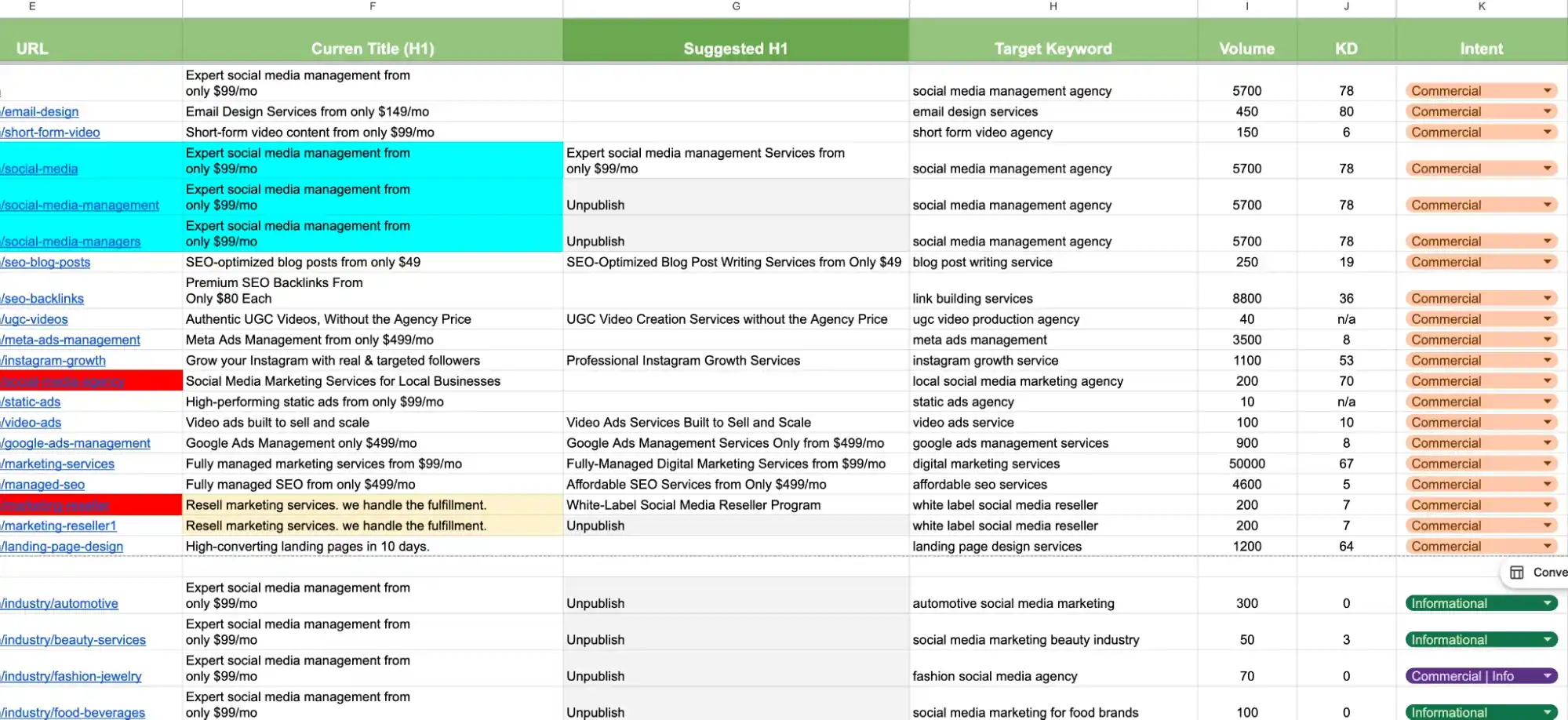
To do this, you need to map your keywords and other essential details to each URL.
Something like this:
Here is my process.
I export all URLs from the XML sitemap, place them into a Google Sheet, and then go page by page.
For each important landing page, I identify the main target keyword and map the supporting details around it, including search volume, keyword difficulty, intent, metadata, page type, the current data from GSC, etc.
Once that Sheet is ready, auditing becomes much easier.
It helps me quickly spot cannibalization issues because when the keyword mapping is clear, overlapping targets become obvious.
It also helps me understand whether each page is targeting the right keyword, matching the right intent, and speaking to the right audience.
So yeah, keyword mapping is one of the priorities in my B2B SEO audit process.
It gives me a much clearer picture of what the site is trying to do, where the gaps are, and what needs to be cleaned up before any serious growth can happen.
Step 3. Audit Indexation With a Ruthless Eye
Sometimes you can spend weeks auditing a site, fixing content, improving technical SEO, and building backlinks, only to realize that some of the key pages are not even indexed.
Even if you know they’re indexed, that doesn’t always mean they will stay that way.
Pages can get de-indexed later, too, for various reasons. Based on what we’ve seen at our B2B SEO agency, this happens more often than many people think.
What I recommend.
If the website is relatively small, let’s say around 50 pages, you can check indexation manually every week or every couple of weeks. It does not take that long, and it helps you catch problems early.
You can also check the GSC’s “Crawled – currently not indexed” or “ Discovered – currently not indexed” report (But keep in mind, GSC updates the report after a week or so).
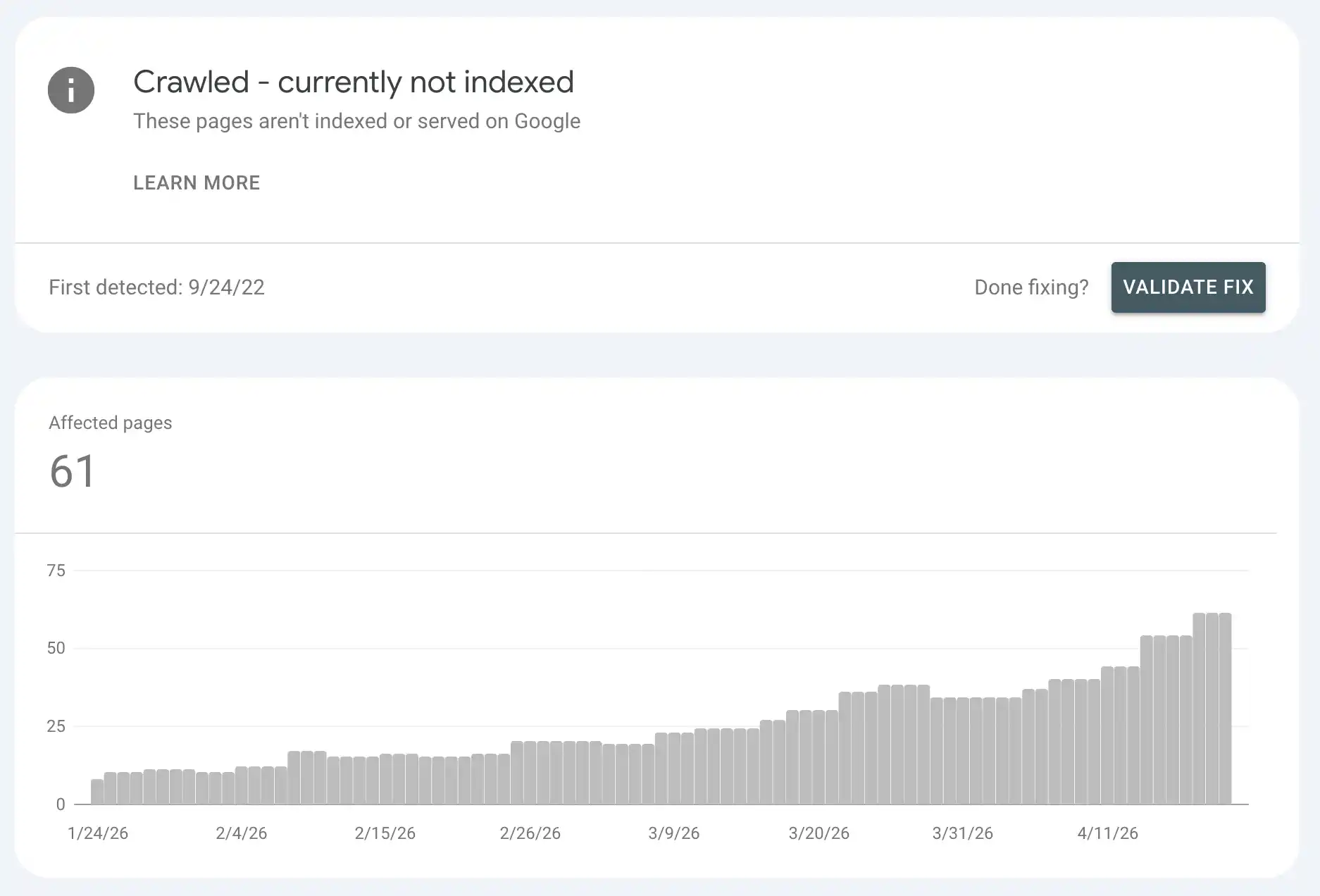
A lot of people assume that once a page is indexed, that’s it. But in reality, it does not always work like that. Sometimes pages quietly drop out, and sometimes there is no obvious reason at all.
If you need a more scalable way to track this, you can also automate it. One tool I’ve used for a long time is Indexcheckr.com. It lets you monitor pages on a schedule, whether that’s daily, weekly, or monthly.
In my experience, it works really well. I would not call it perfect, because sometimes the reports are not fully accurate, but overall, it has been very useful for us over the last couple of years.
Step 4. Connect Search Intent to Conversion Paths
B2B users are usually not looking for a quick purchase (I’m sure you agree with me). Most of the time, they are trying to solve a business problem, evaluate options, compare vendors, understand costs, reduce risk, or convince other people inside the company.
What I know is that a B2B SEO audit should never stop at rankings and traffic alone. You also need to check whether search intent is connected to a logical conversion path.
Step #4
Audit the ratio between informational and commercial content.
For example, if most of your top-ranking pages are blog posts answering broad questions, that may look good in a report, but it doesn’t always mean the SEO strategy is doing its job.
You should analyze the data to see if you’re attracting traffic.
A lot of B2B websites have a blog on one side and a contact page on the other, but almost nothing in between.
During the audit, I always look for assets that help bridge the gap between early research and commercial action, including comparison pages, use case pages, industry pages, pricing-related content, calculators, templates, white papers, case studies, service explainers, and other decision-stage content that helps the visitor move forward with confidence.
My process looks like this:
Steps of a B2B SEO Audit
Intent Mapping
Group key pages by where the buyer is in the journey: research, comparison, validation, or action.
Intent gaps foundAsset Review
Check whether the site has the right decision-stage assets, including comparisons, case studies, templates, calculators, and use-case pages.
Missing assets listedPath Analysis
Review how visitors move from blog posts and educational pages to service pages, demos, pricing content, or sales conversations.
Friction points mappedCTA Audit
Check whether each page has the right next step based on intent, not just a generic “Contact Us” button everywhere.
CTAs matched to intentTrust Facts Check
Look for proof that supports conversion, such as case studies, testimonials, screenshots, stats, expert input, and clear service positioning.
Trust gaps identifiedConversion Roadmap
Turn the findings into a cleaner buyer path with better internal links, stronger CTAs, and the right assets in the right places.
Buyer path rebuiltI also check whether informational pages do their job beyond just bringing visits (E.g., do they have CTAs?).
Yep, it’s very important to pay attention to your B2B SEO content strategy to make sure you’re investing in stuff that makes a lot of sense for business ROI.
When it comes to auditing this, you can absolutely do it manually, and honestly, I still recommend manual review, at least at the beginning.
Go through your top pages, look at their intent, their internal links, their CTA structure, and the role each one plays in the buyer journey.
I’m sure you’ll get a much better feel for what is happening.
At the same time, if you want to speed things up, tools can help. For example, you can connect Google Search Console data to Claude and let it analyze pages, queries, click patterns, and intent gaps at scale.
We do this internally at our agency, and it works really well.
Claude is especially useful when you need help sorting large sets of keywords and page-level data, spotting patterns, and identifying pages that bring visibility but do not connect well to conversions.
So when you audit this section, do not just ask, “What pages get traffic?” Ask, “What role does this page play in the buying journey, and what does it help the visitor do next?”
Step 5: Stress-Test the Technical Foundation for Growth
Next, pay attention to technical SEO (I’m not saying it’s B2B specific). I’m sure you can find plenty of technical SEO checklists, and some of them may even go deeper than what I’m going to cover here.
That’s not really the point of this section. What I want to do here is make sure you’re not wasting money, time, and internal resources fixing the wrong things.
Here is my technical SEO checklist you should audit first:
Technical SEO Checklist (Basic Level)
Before touching content, backlinks, or conversion strategy, these are the issues I want reviewed first.
| Audit Area | What to Check | Priority Score |
|---|---|---|
| Crawlability | Check robots.txt, crawl blocks, noindex tags, and important pages excluded from crawling. | 10/10 |
| Indexation | Review indexed vs. non-indexed pages in Google Search Console. | 10/10 |
| XML Sitemap | Check if the sitemap is clean, updated, and only includes canonical, indexable URLs. | 8/10 |
| Site Architecture | Review how key pages are structured and how deep they sit from the homepage. | 9/10 |
| Internal Links | Check whether priority pages receive enough relevant internal links. | 8/10 |
| Canonical Tags | Review canonical tags on duplicate, filtered, paginated, or similar pages. | 9/10 |
| Redirects | Check 301s, redirect chains, loops, and broken redirects. | 8/10 |
| Broken Links | Find internal 404s, broken external links, and linked pages that no longer exist. | 7/10 |
| Core Web Vitals | Review LCP, INP, CLS, mobile speed, and page template performance. | 8/10 |
One of the most common SEO mistakes I see is businesses relying on tools like Ahrefs, Semrush, Screaming Frog, or even Google Search Console, then trying to fix every single issue those dashboards show.
In my opinion, that’s a big mistake.
Not every warning is important, believe me, and not every issue deserves action.
Step 6. Audit Your Brands AI Visibility
Today, it’s very hard to imagine B2B SEO lead generation without the help of AI search engines like ChatGPT and Claude. It’s already shaping how people discover brands, compare options, and shortlist vendors.
OpenAI says ChatGPT has more than 700 million weekly active users, and McKinsey reported that 45% of B2B buyers used AI during a recent purchase journey. They also found that 67% of B2B buyers now prefer a rep-free experience, which tells you just how much modern buying behavior is shifting toward self-education and independent research.
That’s why I believe AI visibility now deserves a place in a serious B2B SEO audit.
Just to be clear, I’m not saying AI SEO is a completely separate game with a completely different foundation.
In many cases, the same things that help you perform in traditional search also help you appear in AI search engines. However, there are also a few extra things worth paying attention to if you want your website and brand to appear more often in LLM-driven discovery.
Here is my AI visibility audit checklist for B2Bs
AI Visibility Audit Checklist for B2Bs
When I audit AI visibility for B2B companies, I’m checking why the brand appears, where the information comes from, which competitors are mentioned instead, and what signals are missing from the website, content, backlinks, PR, and third-party profiles.
| Audit Area | What to Check | Priority |
|---|---|---|
| Brand Mentions in AI Tools | Test prompts in ChatGPT, Gemini, Perplexity, and Copilot to see if your brand appears for category, comparison, and “best company” searches. | 10/10 |
| Listicle Presence | Check whether your brand appears in third-party listicles, “best of” articles, comparison pages, and industry roundups. | 10/10 |
| Entity Clarity | Review whether your website clearly explains your company, services, industries, location, founders, and proof points. | 9/10 |
| Branded Search Demand | Check whether people search for your brand name, service + brand, and comparison-style branded queries. | 6/10 |
| Third-Party Reputation | Review mentions, reviews, profiles, interviews, guest posts, PR features, podcasts, and expert quotes across trusted sites. | 9/10 |
| Bottom-Funnel Content | Review comparison pages, alternative pages, use case pages, pricing pages, case studies, and industry pages. | 10/10 |
| Bing Visibility | Check how well your brand ranks in Bing for service, category, and comparison keywords. | 8/10 |
| Author & Expert Signals | Check whether your founders, executives, and subject-matter experts have visible profiles, bios, LinkedIn presence, and external mentions. | 6/10 |
| Structured Data | Review Organization, Person, Service, Product, FAQ, Review, and Article schema where relevant. | 7/10 |
We now get at least one client per month from AI search engines (Honestly, mostly from ChatGPT).
So in this step of the audit, I recommend reviewing how visible your brand is across AI search engines, how clearly your services and expertise are presented, whether your content is citation-worthy, and whether your website gives LLMs enough confidence to mention you in the first place.
You can also consider our AI SEO services to take your business to the next level.
Step 7. Review Content Freshness & Decay
It does not matter whether we are talking about 10 years ago or 10 years from now. People will always value content that feels fresh, up to date, easy to understand, and directly useful.
Nobody wants to visit a page full of old examples, outdated claims, and unnecessary jargon when they are trying to solve a real problem.
At the same time, I would agree that things are a little different now, because today your content has to work for traditional search engines and AI search engines, and they don’t always process or surface content in the same way.
Below, I’m going to share the checklist I personally use to review content freshness and decay, followed by a few best practices to help you keep important pages updated without turning content maintenance into chaos.
B2B Content Freshness & Decay Audit Checklist
When I review content decay for B2B websites, I’m not only checking traffic drops. I’m checking whether the page still supports the buyer journey.
| Audit Area | What to Check | Priority Score |
|---|---|---|
| Pipeline Page Drops | Check service pages, comparison pages, industry pages, and use case pages that lost clicks, rankings, or qualified leads. | 10/10 |
| BOFU Keyword Decline | Review drops for high-intent terms like “best,” “alternatives,” “pricing,” “services,” “agency,” “software,” and “for [industry].” | 10/10 |
| Intent Shift | Check whether Google now favors deeper guides, comparison pages, product pages, listicles, or more expert-led content. | 10/10 |
| Outdated Proof | Review old case studies, client logos, testimonials, screenshots, performance claims, and industry examples. | 9/10 |
| Offer Misalignment | Check whether the page still reflects your current services, positioning, pricing model, target industries, and sales process. | 9/10 |
| Competitor Content Gap | Compare pages against competitors that added stronger examples, tables, FAQs, templates, demos, or buyer-specific sections. | 9/10 |
| Conversion Path Decay | Review CTAs, internal links, forms, demo buttons, lead magnets, and next-step pages connected to the content. | 9/10 |
| Internal Link Loss | Check whether updated blogs, service pages, and hub pages still link to the page with relevant anchors. | 7/10 |
| AI Search Relevance | Check whether the page gives AI tools clear service context, industry fit, expert signals, and third-party proof to understand the brand. | 8/10 |
Of course, not everything can be fixed at once. A lot of this takes testing, trying, and experimenting until you understand what works in your market and what doesn’t.
But based on what we’ve seen after internally auditing dozens of B2B company websites, I can tell you this is a very important part of the process.
-
1
Audit by revenue importance
In B2B, a page with 200 visits sometimes is more valuable than a blog post with 10,000 visits if it supports demos, quotes, sales calls, or deal validation.
-
2
Audit the page against buyer questions
Don’t only ask, “Is this optimized?” Ask, “Would a skeptical buyer still have major questions after reading this?” If yes, add the missing context before adding more keywords.
-
3
Look at content ownership
B2B content often gets outdated because no one owns it after publishing. During the audit, assign each important page to someone who understands the offer, the market, and the sales objections.
Step 8. Evaluate Backlink Strength, Trust, and Reputation
At this stage, you should review your overall backlink profile, brand mentions, and broader brand reputation if you’re running a local B2B SEO campaign.
The first thing I recommend is exporting your backlink data from multiple sources, not just one. You can pull it from Ahrefs, Semrush, Google Search Console, and even Majestic if you want a wider view.
Because one tool rarely shows the full picture.
Each one picks up different links, so combining the data gives you a much more reliable foundation. After that, remove duplicates and review the full backlink profile with a cleaner, more complete dataset.
When you do this, don’t limit yourself to BS metrics like the ratio of nofollow to dofollow links, total referring domains, or whether a linking site has traffic.
Here is what you should audit there:
Backlink Profile Audit Checklist
Check whether your backlinks look natural, relevant, earned, safe, and strong enough to support rankings without creating unnecessary risk.
| Audit Area | What to Check | Priority Score |
|---|---|---|
| Referring Domain Quality | Check whether backlinks come from relevant websites with traffic, content quality, authority, and a clean history. | 10/10 |
| Link Relevance | Review how closely linking websites match your niche, audience, industry, or surrounding topic. | 10/10 |
| Anchor Text Profile | Check branded, exact-match, partial-match, generic, and URL anchors for over-optimization. | 10/10 |
| Link Destination Pages | Check whether backlinks point only to the homepage, or if authority is also going to service pages, guides, tools, and other key assets. | 9/10 |
| Toxic or Spam Links | Identify links from hacked sites, spam directories, adult/gambling pages, foreign-language spam, or irrelevant link farms. | 9/10 |
| Link Velocity | Review whether the site gained or lost links too fast compared with normal growth and competitor patterns. | 8/10 |
| Lost Backlinks | Check important lost links, removed pages, broken target URLs, and whether valuable links can be reclaimed. | 8/10 |
This is also where I’d strongly suggest not getting too obsessed with DR, DA, or any similar third-party metric. Those numbers are helpful for quick filtering, but they should never replace actual judgment.
Another thing I always look at is the source of link acquisition.
Where are most of the links coming from? Are they mostly paid placements? Are you naturally earning links through useful content? Is there a healthy mix?
You should also audit which pages and content types attract the most backlinks. This is one of the most useful parts of the process (Actually, one of my favorite ones).
Sometimes you’ll notice that a company earns most of its links through original research, statistics pages, industry reports, useful tools, or very specific educational content.
Once you see that pattern, you can rely on it.
For example, if statistics content attracts the most backlinks, that may be a sign to create more data-driven assets. If comparison pages or original studies perform well, that gives you direction, too.
Step 9. Review the Site Like a CRO Consultant
SEO experts do a lot today. They optimize, they write, they test, and whether they like it or not, they also influence conversion performance in a very direct way.
Personally, I never enjoy projects that get a lot of traffic but convert badly. To be very honest, such a project bothers me more than it should. You do all this work, you grow visibility, you bring people in, and then almost nothing happens.
For me, that is never a satisfying result.
Especially in B2B, traffic alone means very little. What really matters is how many qualified leads you generate from your traffic.
Sometimes, even the best blog content and well-written landing pages fail to generate leads, and you cannot always blame SEO alone. Sometimes the issue is the offer, the CTA, the page flow, the trust signals, the form experience, the internal linking, or simply the fact that the page does not move the visitor any closer to action.
This is my checklist:
-
1
Message-to-market fit
Review whether the page speaks to the exact buyer, industry, pain point, and company type. A B2B page can rank well and still fail if the visitor feels the offer is too broad or not built for their situation.
-
2
CTA clarity
Check whether the next step is obvious without feeling aggressive. For B2B, the CTA should match the buying stage: book a call, request a quote, view case studies, download a template, compare options, or talk to an expert.
-
3
Proof near the claim
Review where case studies, client logos, testimonials, numbers, screenshots, and expert quotes appear. In B2B, proof should support the exact promise being made, not sit randomly at the bottom of the page.
-
4
Decision-stage support
Check whether the page helps buyers compare, justify, and move forward internally. Strong B2B conversion pages usually answer questions around pricing, process, timelines, deliverables, risks, results, and who the service is best for.
When I review this part, I like to combine manual review with a few supporting tools. The manual part is still very important. You need to go through the site page by page and look at it with a buyer’s eyes.
Then, if you want more support, tools can help you validate what users are doing.
Heatmaps, session recordings, form analytics, and user behavior tools can quickly show where people stop scrolling, where they hesitate, what they ignore, and where they drop off.
So yes, in a great B2B SEO audit, I would absolutely include conversion review as part of the process.
Step 10. Review Reporting, Attribution, and SEO Measurement
Everything starts with the strategy and ends with reporting. It is one of the clearest ways to understand whether the SEO campaign is working or just creating activity.
I’m sure most agencies and freelancers provide reports with keyword rankings, traffic numbers, and GSC data. But in B2B SEO, and honestly in SEO in general, there is a lot more you should be measuring.
Here is what you should audit in your B2B SEO reporting:
B2B SEO Report Audit Checklist
A useful report should show what changed, why it changed, what it means for pipeline, and what the next priorities are.
| Report Area | What to Audit | Priority Score |
|---|---|---|
| Executive Summary | What to Audit | Priority Score |
| Executive Summary | Check whether the report clearly explains wins, losses, risks, and next steps in plain business language. | 10/10 |
| KPI Alignment | Review whether the report tracks the right B2B KPIs: qualified leads, demos, calls, SQLs, assisted conversions, and pipeline influence. | 10/10 |
| Organic Traffic Quality | Check whether traffic growth is coming from relevant buyers, industries, regions, and intent levels, not just random blog visits. | 10/10 |
| Keyword Movement | Review ranking changes for BOFU, MOFU, branded, competitor, comparison, and industry-specific keywords. | 9/10 |
| Conversion Performance | Audit organic form fills, booked calls, demo requests, quote requests, content downloads, and conversion rate by page type. | 10/10 |
| Backlink Profile Changes | Review new links, lost links, referring domain quality, anchor text profile, link relevance, and risky patterns. | 6/10 |
You should also review attribution carefully. A user may discover your brand through a blog post, come back later through a branded search, then convert after visiting a service page or booking page.
So if you only look at last-click attribution, you may completely undervalue SEO’s role in the process (GA4 is a good tool for this)
Next, audit the quality of the report itself. Is it easy to understand? Is it focused on what’s important? Does it connect SEO activity to business outcomes?
This is also where you can review whether you are tracking the right KPIs in the first place.
Depending on the project, that might include non-branded clicks, rankings for money pages, demo requests, contact form submissions, qualified leads, assisted conversions, pipeline influence, organic landing page performance, CTR trends, and page-level growth across the buyer journey.
Download: B2B SEO Audit Template
A practical audit template for reviewing technical SEO, content gaps, backlinks, AI visibility, conversions, and reporting quality across B2B websites.
What SEO Tools Do You Need?
At the very least, I’d recommend having access to either Ahrefs or Semrush. You don’t need both in the beginning. One of them is usually enough to handle most of the core work, whether that is keyword research, competitor review, backlink analysis, or general SEO checks.
You should also have access to Screaming Frog or Sitebulb for technical SEO.
If the site has up to 500 URLs, Screaming Frog’s free version is enough for a basic audit, which is great if your budget is limited. Sitebulb is also a strong option, and its free trial is very useful if you want to test it on a project without committing right away.
Especially in the beginning, it is much better to work with a smaller setup and focus on understanding what you are looking at. A lot of the value still comes from manual analysis, your own judgment, and your ability to look at a website with real SEO experience instead of blindly following whatever a dashboard tells you.
What Serious Teams Should Do After the Audit?
Of course, a lot depends on the website, the market, the competition, internal resources, and how messy things are in the first place. But in general, the work starts after the audit, not during it.
What to Do After a B2B SEO Audit
Implementation roadmap for turning audit findings into pipeline-focused SEO work
Prioritize the Real Problems
Turn the audit into a clear action plan. Separate urgent technical fixes, revenue-page improvements, content gaps, backlink risks, and conversion issues instead of trying to fix everything at once.
Output: Priority roadmap readyFix the SEO Foundation
Resolve the issues that can block crawling, indexing, speed, internal links, canonicals, redirects, schema, and key page visibility.
Output: Core fixes implementedRebuild Money Pages
Improve the pages that matter most for B2B leads: service pages, industry pages, comparison pages, use case pages, pricing-related pages, and case studies. Make them clearer, sharper, and easier for buyers to trust.
Output: High-intent pages improvedClose Content & Authority Gaps
Refresh decaying content, create missing BOFU and MOFU assets, strengthen internal links, and build authority around the topics where competitors are already winning.
Output: Content gaps closedTrack, Improve, and Scale
Monitor rankings, qualified traffic, demo requests, booked calls, assisted conversions, and AI visibility. Use the data to keep improving pages, expanding content, and building stronger authority over time.
Output: SEO roadmap compoundsPersonally, after the audit, I always review everything again in context. I look at the market, the level of competition, the full list of findings, the business priorities, and the realistic growth opportunities.
Then I define the strategy, the next steps, and the order in which things should happen.
Common B2B SEO Audit Mistakes
I think the number one mistake in SEO audits in general is that experts or agencies rely far too much on tools, dashboards, and the same checklists that every second audit guide repeats.
In my opinion, that is why many businesses go through months of “SEO work” and still see nothing meaningful happening. So before hiring a B2B SEO agency, think twice.
If we are talking about B2B SEO audit mistakes specifically, a lot of the problems are still the same, but there is one issue I see more often than I should: agencies don’t look at the content deeply enough.
They review pages too quickly, trust BS metrics too much, and completely miss what is happening at the core.
They miss whether the page matches the right intent, whether it speaks to the right audience, whether it supports the buying journey, and whether it has any real chance of turning visibility into pipeline.
The Bottom Line
B2B SEO audits are one of my favorite parts of the process. First, because this is not standard checkbox SEO. It takes a different way of thinking, a deeper look at the business, and a much clearer understanding of how strategy, content, technical SEO, authority, and conversion all work together.
In this guide, I shared the B2B SEO audit checklist I personally believe in, including the template we use internally at B2BSEO.io. Of course, a lot will always depend on the specific case, the market, the competition, and the stage the business is in.
But overall, this is the framework I’d strongly recommend following if you want the audit to lead to something useful, not just another document full of generic tasks. I hope you found it valuable, and I’ll see you in the next one.
What Is a B2B SEO Audit?
A B2B SEO audit is a full review of how well your website can attract the right business audience from search and turn the attention into leads. In simple words, it is the process of checking whether your SEO makes sense for a B2B company.
How Often Should a B2B Company Do an SEO Audit?
In my opinion, a proper B2B SEO audit should be done at least once or twice a year. That is usually enough to catch major issues, review performance properly, and adjust the strategy before small problems turn into expensive ones.
At the same time, some situations call for audits much sooner. For example, if traffic drops, leads slow down, rankings become unstable, the website gets redesigned, or the company starts targeting new services, markets, or industries, I would not wait for the next scheduled audit. I would review everything as early as possible.
So, while a full audit does not need to happen every month, regular check-ins are absolutely essential.
How Long Should a Proper B2B SEO Audit Take?
That depends on the size of the website, the complexity of the business, the market, and how deep you want to go.
For a smaller B2B website, a proper audit may take a few days. However, if you’re running a B2B enterprise SEO campaign or a more complex site, it can easily take five to six weeks, sometimes even more if you are reviewing content quality, strategy, keyword mapping, technical SEO, backlinks, CRO, and reporting seriously.
If someone promises a “complete” audit in a few hours for a serious B2B company, I would honestly question how deep they are really going.
Does Every Technical Issue Need Immediate Attention?
No, absolutely not.
This is something I’ve said many times because it is one of the biggest mistakes I see in SEO. Not every technical issue needs immediate action, and not every issue shown in a dashboard is a real problem.
A lot of businesses waste time trying to clean up every warning from tools like Google Search Console, Ahrefs, Semrush, or Screaming Frog, even when some of those issues have little to no impact on performance.
For example, in many Google Search Console accounts, you will see all kinds of reported issues. But the truth is, some of them are completely manageable, some are temporary, and some don’t hurt the website in any meaningful way.
Written by
Ashot NanayanSEO Strategist
Ashot Nanayan is an SEO strategist and the founder of B2BSEO.io. He helps B2B companies build search systems that do more than rank pages. His approach connects Google visibility, AI search presence, content depth, authority, and buyer intent, so brands appear where serious decisions start.