Top 8 B2B SEO Content Strategies to Attract Qualified Leads

Ashot Nanayan
SEO Strategist
Table of content
Our agency website generates over ten to fifteen leads per week from blog content alone, and I believe coincidences like this don’t happen every day. I’m not even mentioning that, in the last couple of years, I’ve been working on dozens of B2B SEO projects, ranging from service providers to eCommerce and local B2B clients in competitive markets, where our content strategies have played an enormous role.
We’ve tested everything, from the old-school SEO era to the AI visibility era, where potential leads are typing eight to ten words into prompts to get answers.
So, before I get too old and forget all that stuff, I decided to share everything we’ve tested, tried, and failed at inside our specialized B2B SEO agency, and also as a freelancer. If you’re already reading this guide, start applying everything step by step to your own project, or just share my article so it can help others.
Ready to grow smarter?
Book a free 30-minute strategy call with our team. We'll audit your search visibility and build a custom action plan.
What Content Types Work Best for B2B SEO?
I know this is one of the most common questions B2B companies search for, and in many guides, especially when the writer isn’t an expert, you’ll find generic advice such as “BOFU content works better” or “listicle-style articles are great.”
I’m not saying otherwise, but answers like these are very confusing because it all depends on many factors, such as your niche, buyer journey, current SEO health, website authority, and many other important considerations.
So, please note that there is no one-size-fits-all answer here without diving deep into your specific case. However, I tried to combine our internal data, experience, and some B2B content marketing sources to put together what you need.
Here are the top types of content that work best for B2Bs:
B2B Content Types With the Highest ROI
We’ve researched and put together the B2B content types that usually bring the strongest return, from comparison pages and case studies to templates, industry pages, and buyer-focused guides.
| Content Type | Examples | Average ROI |
|---|---|---|
| Comparison pages | “X vs. Y,” “Best alternatives to X,” competitor comparison pages | Very high |
| Use case pages | By role, team, product use case, pain point, or workflow | High |
| Industry pages | SaaS, healthcare, finance, manufacturing, logistics, construction | High |
| Case studies | Client success stories, before-and-after growth stories, campaign breakdowns | Very high |
| BOFU guides | Pricing guides, vendor selection guides, buying checklists, “how to choose” guides | Very high |
| Templates and tools | ROI calculators, audit templates, checklists, scorecards, spreadsheets | Medium to high |
| Problem-led blog posts | Cost guides, mistake guides, risk guides, process improvement articles | Medium |
Traffic Content vs Revenue Content
I’m sure you’re not here to see how I can help you generate more traffic just to get a nice-looking Ahrefs chart, just making sure we’re on the same page, lol. And if you’re not, that’s perfect, because below I’m going to share eight B2B SEO content strategies that can help you generate more qualified leads and pipeline instead of empty traffic.
Right below, you’ll also see a comparison chart so we can make sure we understand each other.
Traffic Is Nice. Revenue Pays the Bills.
Main goal
Attract more visitors
Attract better buyers
Keyword Type
High-volume informational terms
Commercial and decision-stage terms
Audience
Broad readers
Potential customers
Conversion Role
Builds awareness
Creates pipeline
Success Metric
Sessions and rankings
Leads, SQLs, pipeline, revenue
Strategy #1: Build Industry-Specific BOFU Content
It’s not the first time I’ve said that investing in BOFU content is one of the best B2B SEO strategies, especially now, when general TOFU and MOFU topics seem to be slowly getting eaten by LLMs and AI Overviews.
Don’t believe everything you see in Ahrefs competitor analysis reports. For example, right now we’re running an SEO campaign for an IT service provider that Ahrefs shows as getting over 10K traffic, while in the GSC report, it’s just 1K visits per month.
What I’m saying is that search is evolving, and in my opinion, the days when you could generate traffic by targeting “What is this?” topics are gone.
Based on our experience, here are the top BOFU topic types, by percentage, you can consider.
BOFU Content That Usually Generates the Most Revenue
Based on the B2B projects we’ve worked on, these are the content types I’d usually prioritize when the goal is not just traffic, but qualified pipeline.
Comparison Pages
34%
Case Studies
26%
Industry Pages
18%
Product-Led Guides
22%
I would highly recommend conducting in-depth keyword research to explore all the low-hanging fruit around you before developing your content strategy, especially if you’re doing SEO for B2B SaaS or similar sectors. I’m sure you’ll find dozens or even hundreds of opportunities.
Don’t just prioritize topics by search volume. In B2B, that often makes no sense. Prioritize them by the value they can bring.
Remember, the best BOFU topics are not always the highest-volume keywords. They are the topics buyers search for when they already know they need a solution but still need confidence, proof, and clarity before taking action.
Strategy #2: Turn Sales Call Objections Into Search-Driven SEO Content
If you want to generate leads with SEO, you should understand what your ideal clients are looking for and what they need. The thing is, a lot of interesting conversations sometimes happen right during calls, when one question leads to another.
I recall that some time ago, one of our healthcare SEO clients asked us to secure high-DR backlinks for their website, and I was thinking, “Again, I have to explain that DR has nothing to do with SEO.” So I created a very good article on what DR is and how to avoid vetting opportunities based only on DR.
This is a simple example, maybe not the best one, but I’m sure you get what I mean.
Sometimes, you shouldn’t care too much about keyword volume or KD. It’s more effective to create content based on your clients’ pain points, questions, and even requirements.
So, strategy #2: turn sales calls objections into content!
Strategy #3: Create “Your brand vs Competitors” Pages
Of course, when a big brand like HubSpot creates comparison pages against competitors, it’s easier to justify because the keywords already have search volume. People are actively searching terms like “HubSpot vs X,” so the opportunity is obvious.
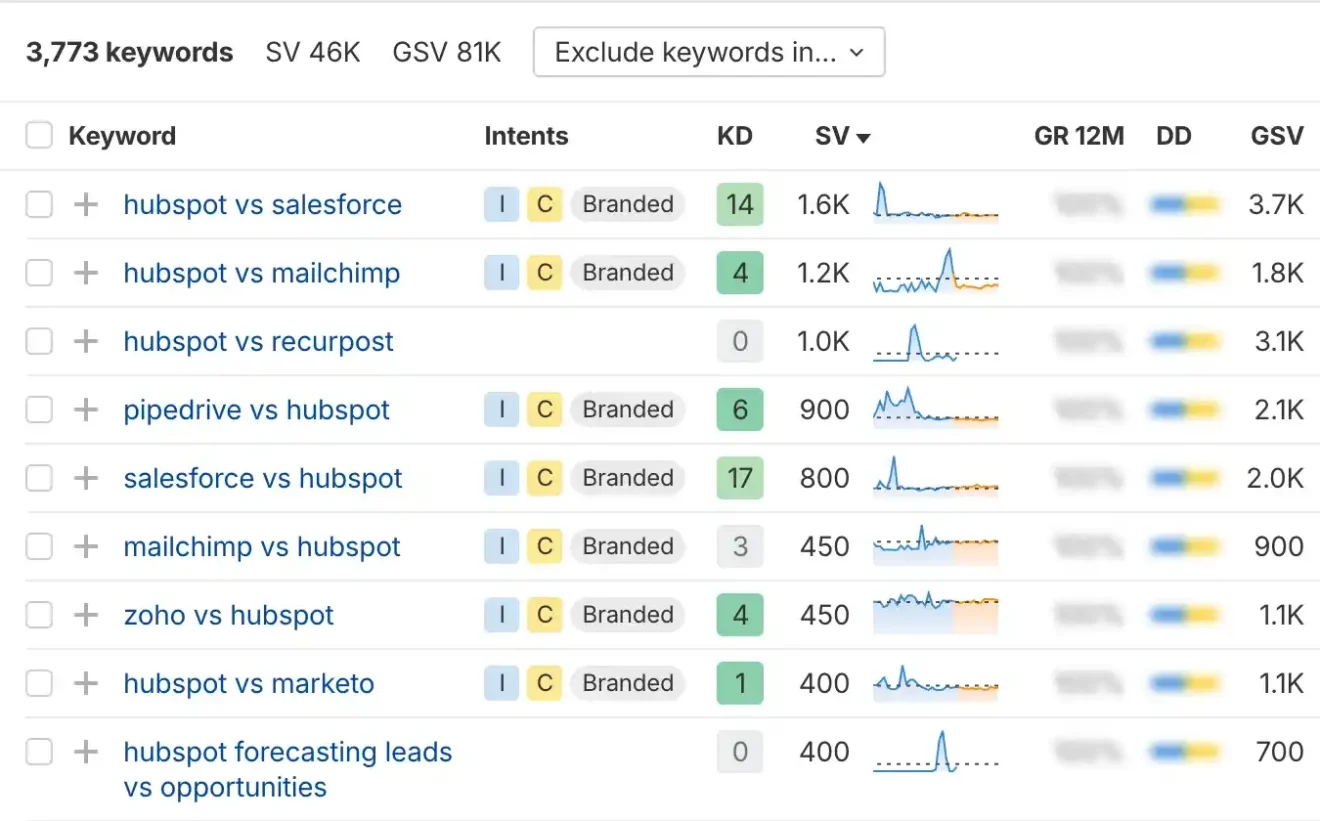
But what if you’re a newer B2B SaaS company, or a brand with low search demand, and your “brand vs competitor” keyword shows no volume at all?
I know what you think, and that’s why I’m going to explain everything step by step.
The reason is that sometimes a potential buyer discovers your brand first, then starts comparing you with a better-known competitor to understand what you offer, what the differences are, whether you’re more affordable, more specialized, easier to use, or a better fit for their case.
Comparison content helps you control the conversation when buyers are in evaluation mode. They also give you a chance to position your product properly instead of letting review sites, Reddit threads, or random affiliates define the comparison for you.
I’m smart, right (lol)?
Recently, I was checking Nathan Gotch’s Rankability and noticed they’re doing the same thing I’m talking about.
So yes, even if the keyword volume looks low or nonexistent, don’t worry about it. In B2B SEO, not every strong opportunity appears clearly inside Ahrefs or Semrush. Sometimes the value is in influencing decision-making, not just capturing reported search volume.
Strategy #4: Use CRM Data to Discover Which Content Generates SQLs
Believe it or not, a lot of companies still look at content performance through the usual SEO numbers like clicks, impressions, rankings, and maybe even on-page conversions, and it often seems like they don’t care about SEO ROI at all.
But have you ever asked yourself which content pieces are actually generating SQLs?
Let’s keep it simple.
A very simple example of content that can generate SQLs is something like “Best ERP Software for Construction Companies” or “Acumatica vs NetSuite for Construction Businesses.”
In such cases, they are already aware of the problem, already looking at options, and are much closer to making a decision. Maybe they are comparing vendors, trying to get internal buy-in, or looking for the final confidence before booking a demo.
Now compare it with a topic like “What Is ERP Software?” or “Benefits of Digital Transformation in Construction.” Can these topics bring traffic? Yes, of course. Can they sometimes help the brand? Sure.
But in many cases, they have weak SQL potential because the person searching is often still in learning mode. They may be a student, a junior employee, someone doing casual research, or just a person very early in the journey.
I’m sure we got each other.
Strategy #5: Build Comparison Pages Around Procurement Searches
This one is one of my favorite B2B SEO content strategies. But first things first, these are the searches people make when they are already comparing options before choosing a vendor, product, platform, or supplier.
They are no longer searching broad educational topics. They are searching things like “best B2B SEO agencies,” “X vs Y,” “top suppliers of X,” “best procurement software for healthcare,” or “best office pods for open-plan offices.”
Here is the complete breakdown:
For example, if someone searches for “best warehouse management software for 3PL companies,” there is a good chance they are not just learning for fun. They are probably evaluating vendors, collecting options, or preparing to buy. The same thing happens when someone searches “NetSuite vs Acumatica for manufacturing” or “best wholesale dermal filler suppliers.”
Of course, this strategy works best when your market already has comparison behavior. If buyers in your niche usually review vendors, request quotes, compare software, or shortlist suppliers, this is a very strong play.
If your product is too new and there is no comparison demand yet, you may need to create demand slowly through category education first.
Still, in many B2B markets, this is one of the best content opportunities you can go after.
Strategy #6: Create Executive-Level Content
In many industries, the person reading your article and the person signing the contract are not the same (I’m sure you will agree with me). But at some point, the conversation usually moves up.
The final decision may involve a founder, CMO, VP, director, procurement head, or another executive-level stakeholder who cares less about features and more about outcomes, risks, numbers, implementation, and business impact.
So you should not forget about executive-level content. I mean craft content around the questions decision-makers ask before saying yes.
For example, a practitioner may search for something like “best CRM integrations” or “how to improve lead routing.” But an executive is more likely to care about things like “CRM implementation cost,” “how long CRM migration takes,” “how to compare CRM vendors,” or “how to justify CRM investment internally.”
See the difference?
So, if you want better B2B SEO results, don’t create content only for people gathering information. Also, create content for people making financial and strategic decisions.
Strategy #7: Strengthen AI Search Visibility With Listicle-Style Content
Nobody can say otherwise: LLMs (E.g., ChatGPT or Claude) love listicle-style articles, and in many cases, they rely on them when answering queries. Just search for things like “best B2B SaaS SEO agencies,” “top CRMs for construction companies,” or “best workplace management software,” and you’ll quickly notice what keeps appearing. In most cases, it’s a listicle, a comparison-style roundup, or some kind of curated “best options” page.
That’s why I believe this is one of the smartest content plays right now, especially for B2B brands that want stronger AI search visibility on top of regular organic rankings.
Listicle-style content makes it easier for LLMs and even traditional search engines to understand the topic, the category, the options, and the differences between them.
It gives them a clear format they can pick from when they need to summarize a market, compare solutions, or recommend providers.
By the way, we also provide AI SEO services for B2B companies and help brands improve their visibility across AI-driven search experiences, not just traditional search engines.
Strategy #8: Turn Blog Content Into YouTube Videos
Everyone is talking about Google, AI Overviews, LLMs, and all that stuff, but let’s not forget that YouTube remains the world’s second-largest search engine
If you really want to stay visible everywhere, I would say SEO is no longer just search engine optimization; it’s search everywhere optimization.
I mean, your brand shouldn’t depend only on Google rankings. You should try to appear wherever people search, compare, learn, and validate things.
One of the strongest B2B content strategies, in my opinion, is when you take your top-performing blog content, analyze the intent behind it, and turn it into YouTube videos.
For example, let’s say you have a blog post that performs well around a topic like “how to choose a B2B SEO agency,” or “B2B SEO ROI.”
If the article is already attracting the right people, why not turn that same idea into a video and give it another chance to bring visibility, trust, and leads?
Pro Tip
Don’t keep your videos separate from your blog content. Add them to relevant articles where they naturally support the topic.
Use AnswerThePublic to check YouTube keyword volumes for the topics you want to turn into videos.
How to Create Content for Long Sales Cycles
-
1
Map content to every buying stage
Long sales cycles usually include early research, problem awareness, vendor comparison, internal approval, and final decision-making. Create content for each stage instead of expecting one blog post or landing page to do everything.
-
2
Answer the questions buyers ask before sales calls
Buyers often research pricing, timelines, implementation, risks, ROI, integrations, support, and alternatives before contacting you. These questions should become blog posts, comparison pages, FAQs, guides, or sales enablement assets.
-
3
Create content for the whole buying committee
In B2B, one person rarely makes the decision alone. Build content for executives, managers, technical teams, finance, procurement, legal, and end users so each stakeholder can understand the value from their own angle.
-
4
Use proof to reduce hesitation
Long sales cycles usually mean higher risk. Add case studies, client examples, benchmarks, testimonials, screenshots, before-and-after results, and real use cases to help buyers feel safer moving forward.
-
5
Connect educational content to commercial pages
A helpful article should not end with a dead stop. Link readers to use-case pages, service pages, comparison pages, pricing explainers, demos, templates, calculators, or case studies that match the topic they just read.
-
6
Repurpose sales objections into content
The best long-cycle content often comes from sales calls. If buyers keep asking the same questions or raising the same concerns, turn those objections into pages that educate, clarify, and move the deal forward before the next call.
How to Measure the ROI of B2B Content
A lot of people overcomplicate this, but the logic is very simple. If you spent money on content, whether that was writing, SEO, design, promotion, or your team’s time, then that content should bring something back.
For example, let’s say you published a blog post and spent $1,000 on it. After some time, the post helped generate one qualified lead that later became a client worth $6,000. In that case, the content clearly paid off.
The formula
ROI = revenue generated from content minus content cost, divided by content cost.
But honestly, in B2B, the bigger challenge is usually not the formula. The bigger challenge is understanding which content influenced the lead.
Top Tools to Measure B2B Content ROI
-
1
GA4
GA4 helps track what users do after landing on your content, including form submissions, demo clicks, downloads, and other key events. It also supports attribution reports for understanding which touchpoints contribute to conversions.
-
2
HubSpot
For B2B teams, HubSpot is useful when you want to connect content performance with contacts, lifecycle stages, SQLs, deals, and revenue. Its revenue attribution reports can show how much closed-won revenue is tied to specific pages, blog posts, or marketing emails.
-
3
Looker Studio
Use Looker Studio to bring SEO, analytics, CRM, and conversion data into one dashboard. This makes it easier to show content ROI without asking clients or leadership to open five different tools.
-
4
CRM and sales pipeline reports
The most important ROI data usually lives in your CRM, not in SEO tools. Track which content-assisted leads became qualified opportunities, what pipeline they created, and which deals eventually closed.
How to B2B Create Content for AI Search and LLM Visibility
Recently, Google published a new guide saying that the best practices for SEO continue to be relevant because their generative AI features on Google Search are rooted in their core Search ranking and quality systems.
I have been saying the same thing for two years.
However, it’s important to note that not all AI search engines (LLMs) rely on Google’s core ranking and quality systems, and, for example, based on my expertise, ChatGPT doesn’t rely on backlinks as Gemini does.
So, here is my checklist:
-
1
Write around full buyer questions, not only keywords
LLM users ask complete questions like “What is the best CRM for a B2B SaaS startup?” or “How do I choose a cybersecurity vendor for healthcare?” Build content that answers these natural prompts directly.
-
2
Make your positioning painfully clear
AI tools need to understand who you help, what you offer, where you fit, and when you are the right choice. Mention your industries, use cases, customer types, product category, service model, and strongest differentiators clearly across key pages.
-
3
Add comparison and decision-stage content
LLMs often help users compare vendors, tools, agencies, methods, and solutions. Create “vs,” “alternatives,” “best for,” “how to choose,” pricing, use-case, and vendor-selection content.
-
4
Use expert-backed answers
Generic content gives AI tools no strong reason to reference you. Add named experts, real opinions, client examples, screenshots, benchmarks, lessons learned, and practical notes from your team.
-
5
Create quotable sections
AI tools prefer clean, direct answers that they can summarize. Add short definitions, quick recommendations, clear steps, pros and cons, comparison tables, FAQs, and “best fit” sections that are easy to extract.
What Is a B2B SEO Content Strategy?
B2B SEO content strategy is the process of planning and creating content that helps your ideal business buyers find you through search and move closer to becoming a lead.
It is about choosing the right topics, matching them to the buyer journey, and creating content that answers questions your potential clients search for before they trust you, contact you, or buy from you.
In simple words, a good B2B SEO content strategy helps you attract the right people, not just more people.
How Often Should a B2B Company Publish Content?
In my opinion, the frequency depends on its goals, resources, competition, and how serious it is about growth.
But in simple words, I would say that it’s much better to publish consistently than to publish too much and then disappear. For many B2B companies, publishing two to four strong pieces per month is already a very good start.
I would always choose quality, consistency, and relevance over volume. At the same time, companies shouldn’t publish so rarely.
So, there is no perfect number for everyone, but a realistic and healthy pace is one that your team can maintain without lowering the quality.
Are Low-Volume B2B Keywords Worth Targeting?
I already talked about this quite a bit in my B2B keyword research guide, but it’s worth repeating here, too.
A lot of low-volume B2B keywords are still worth targeting because search volume doesn’t always reflect business value. In B2B, some of the best keywords may only get a few searches per month, but those searches often come from the exact type of people you want to attract.
What Is BOFU Content in B2B SEO?
Bottom-of-the-funnel (BOFU) content is the type of content people search for when they are already close to taking action.
These are usually the topics they look for when they already know the problem, already understand the category, and are now comparing options, checking pricing, looking for proof, or trying to choose the right vendor.
How Does Content Help Generate B2B Leads?
Content helps generate leads by bringing the right people to your website and answering the questions they already have before they contact you. For example, if someone is searching for solutions, comparisons, pricing, mistakes to avoid, or how to choose the right provider, your content can appear right at that moment and introduce your brand.
They need to feel that you understand their problems, know what you are doing, and can help. Good content does that by educating them, removing confusion, and giving them enough confidence to take the next step.
Written by
Ashot NanayanSEO Strategist
Ashot Nanayan is an SEO strategist and the founder of B2BSEO.io. He helps B2B companies build search systems that do more than rank pages. His approach connects Google visibility, AI search presence, content depth, authority, and buyer intent, so brands appear where serious decisions start.