How to Audit a B2B Website for LLM Visibility and AI Search

Ashot Nanayan
SEO Strategist
Table of content
Believe it or not, positions “1–10” are no longer the full picture, and yeah, AI Overviews, ChatGPT, Gemini, Perplexity, and other LLMs have changed the search experience. Over the last few months, our team has tried a bit of everything. Some things worked great on a few sites, then completely failed on others, even when we did almost the same thing.
However, after a lot of testing and a few disappointments, we found a handful of checks and tactics that keep working across different projects, at least for now. So I decided to put them together and show you how I audit a website specifically for LLM visibility.
If you’re looking for AI SEO services, reach out, and we’ll put together a custom proposal for your site.
Ready to grow smarter?
Book a free 30-minute strategy call with our team. We'll audit your search visibility and build a custom action plan.
1. Crawlability & Indexing Health
Every week, someone asks me, “How do I know if my pages are even seen by AI search engines? Do they crawl the same way Google does? Do I need some special setup just for ChatGPT or Gemini?”
The thing is that most of these large language model systems rely on the public web, and the way they discover content is still tied to normal crawling patterns. I mean, they’re not reinventing the wheel. If Google, Bing, and other major crawlers can reach and understand your pages, LLMs usually can, too.
The thing is that LLMs also tap into different data sources: snapshots, licensed datasets, curated feeds, so you’re not dealing with one single index as you do with Google.
Common FAQs
A big myth I hear is that “LLMs read everything even if it’s not indexed.” No, if your content isn’t discoverable on the open web, or it lives behind a login, or it’s blocked by robots.txt, it becomes much harder for AI search engines to find your content.
Another myth is that you need to “submit” pages to AI engines separately. You don’t. There’s no special submission portal. Fix the fundamentals, and you’re already ahead.
For best practices, keep it simple:
Make your content easy to reach. Keep URL structures clean. Use internal links that help crawlers move around. Make sure every important page can be reached within a few clicks.
Check your index coverage regularly; if Google struggles to index your site, that’s usually a red flag for your LLM visibility, too.
Pro Tip
2. First-Party Experience Signals
Expert-written content is one of the top three factors that decide whether your brand appears in AI search.
Remember, LLMs “eat” generic content very fast. They’ve already seen every “What is X?” and “Top 10 benefits of Y” article on the internet, generated by AI or unknown writers.
So if you want ChatGPT, Perplexity, Gemini, and all the other AI search engines to surface your brand in their answers, you have to give them something they can’t recreate on their own.
I mean real data, your own case studies, screenshots, maybe product results, internal numbers, client stories, experiments, failures, insights; anything that only you can provide.
Top LLM Visibility Factors
These factors are not guaranteed ranking signals. LLMs don't work like traditional Google rankings, and every platform may use different sources, freshness signals, retrieval systems, and trust checks.
| LLM Ranking Factor | How to Optimize | Priority |
|---|---|---|
| Third-party brand mentions | Get mentioned on trusted industry blogs, software lists, comparison pages, podcasts, PR articles, and niche publications. | Very High |
| Clear entity positioning | Make it obvious who you help, what you offer, your category, your use cases, and your main differentiators across your website and external profiles. | Very High |
| Topical depth around your niche | Build strong content clusters around your core services, problems, industries, comparisons, alternatives, pricing, ROI, and use cases. | High |
| Presence in comparison and “best” lists | Earn placements in listicles such as “best B2B SEO agencies,” “top SaaS SEO companies,” or “best tools for [use case].” | High |
| Fresh, crawlable, well-structured content | Keep important pages updated, use clear headings, FAQs, schema, internal links, and avoid blocking AI crawlers when visibility is the goal. | High |
| Reviews, case studies, and proof signals | Publish real case studies, client results, testimonials, expert quotes, and review signals that help AI systems connect your brand with trust. | Medium-High |
So if you’re auditing your B2B SEO for better AI visibility, make sure your overall content strategy is executed by industry experts, especially if your sector falls into the YMYL category.
When developing your B2B SEO content strategy, focus most of your efforts on BOFU content, such as comparison articles, listicle-style posts, or alternative blog posts.
Think out of the box. Today, SEO is “search everywhere optimization”; I mean, be everywhere. Optimize for YouTube, Bing, and other search engines, and even participate in forums and podcasts to make sure your authors are everywhere.
3. Content Structure & LLM Readability
A lot of people assume LLMs “read” content in some mysterious, completely different way compared to Google or other traditional search engines. Our clients are like: “Should we rewrite everything for AI search?” or “Do we need special formatting rules just for LLMs?”
Oh man, no or a little.
Folks, I’m going to disappoint you a little: both traditional search engines and LLMs process content in very similar ways. They’re trying to understand your page, break it into digestible pieces, and extract meaning without friction.
Here is my content audit checklist for LLMs:
Content Audit Checklist for Better LLM Visibility
These are the content areas I’d audit first if I wanted my pages to be easier for AI systems to understand, summarize, and cite.
| LLM Content Audit Factor | What to Check | Priority |
|---|---|---|
| Clear page purpose | Check whether each page clearly explains who it is for, what problem it solves, and what action the reader should take next. | Very High |
| Answer-ready sections | Add direct answers to important questions using simple headings, short explanations, FAQs, definitions, comparisons, and decision-stage summaries. | Very High |
| Topical completeness | Review whether the page covers related subtopics, alternatives, pricing, use cases, pros and limits, examples, and common buyer objections. | High |
| Freshness and accuracy | Update outdated stats, tools, screenshots, examples, pricing references, dates, and claims that may no longer be accurate. | High |
| Internal linking context | Link related guides, service pages, case studies, comparison pages, and BOFU pages so AI systems can better understand the full topic relationship. | High |
| Original proof | Add real examples, case studies, screenshots, client results, expert commentary, quotes, and first-hand insights instead of generic explanations. | High |
| Schema and structure | Use clean HTML, Article schema, Organization schema, author details, clear headings, and descriptive tables. | Medium-High |
Yes, you’ll hear advice like “keep paragraphs under five lines,” “follow semantic headings,” “use short summary blocks,” and so on.
Don’t get me wrong, all of that is good advice. It makes content easier for any system (or human) to parse. However, everything you already know about great content structure for Google still applies to LLMs.
4. External Reputation & Brand Signals
Next, audit your brand’s external reputation and trust signals. However, it’s very important to understand that LLMs don’t evaluate your external factors the same way as Google or other search engines.
For example, for Google, backlinks are still one of the top ranking factors, and I never imagined a successful SEO campaign without backlinks.
However, I’ll admit that ChatGPT started referencing our content and even some of our service pages long before we had what most SEOs would consider strong authority, brand mentions, or other obvious reputation signals.
Here is what you should audit and prioritize:
Top External Factors That Can Influence LLM Visibility
If a brand wants stronger visibility in AI-generated answers, these are the external signals I’d improve first.
Brand mentions
30%
Reviews and reputation signals
25%
Consistent brand/entity information
20
Inclusion in “best” and comparison lists
25%
For example, for AI search engines (LLMs), it seems more important where your brand appears and in what context than what anchor texts other websites use when linking to your content.
I also noticed that LLMs such as ChatGPT and Claude often pick up brand names from listicles like “Best B2B SEO Agencies,” while Perplexity, for example, seems to love diving deep into forums, discussions, and social media content.
Here is our B2B SEO agency’s off-page SEO checklist for LLMs:
Off-Page SEO Checklist for Better LLM Visibility
Based on our experience, LLM visibility is rarely influenced by one single off-page signal. AI tools usually need to see your brand mentioned, validated, and described consistently across trusted external sources.
| Off-Page SEO Checklist | What to Check |
|---|---|
| Relevant backlinks from authority sites | Audit whether your backlinks come from real, relevant websites with organic traffic, editorial standards, and strong contextual placement. |
| Expert quotes and PR mentions | Check whether your team or founder is quoted in media articles, podcasts, newsletters, expert roundups, research reports, or industry interviews. |
| Community and forum mentions | Review natural brand mentions on Reddit, Quora, LinkedIn, niche forums, Slack groups, Discord communities, and industry discussions. |
| Co-citations with competitors | Check whether your brand appears on the same pages as known competitors, category leaders, tools, agencies, or products in your niche. |
5. AI Overview / Generative Answer Eligibility
According to SEMrush research, AI Overviews appeared in 13.14% of U.S. desktop Google searches in March 2025, based on an analysis of 10M+ keywords. Thirteen percent may not sound huge at first, but if you run SEO for businesses every day, you already know what it means.
CTRs are very low, really.
Whether we like it or not, AI Overviews is changing how content performs, and in some cases, it forces us to rethink our entire content strategy from scratch.
On the other hand, and this is the part most SEOs don’t talk about, AI Overviews can send high-quality and relevant traffic.
Last year, we had a case study where one of my client projects generated over 6,000 visits from AI Overviews alone.
I mean, it’s possible, but not always.
Here is my SEO audit checklist specifically for AI Overviews:
SEO Audit Checklist for Google AI Overviews
AI Overviews don't reward every page equally. Google is more likely to surface content that is clear, well-structured, trustworthy, and directly useful for the search intent.
| AI Overview SEO Audit Checklist | What to Check |
|---|---|
| Search intent match | Check whether the page directly answers the main question behind the keyword instead of only targeting the keyword itself. |
| Answer-ready formatting | Add short definitions, direct answers, summaries, comparison tables, steps, FAQs, and clear sections Google can easily extract. |
| Topical completeness | Review whether the page covers related questions, subtopics, examples, pros and cons, pricing, alternatives, risks, and decision points. |
| E-E-A-T signals | Check author details, expert input, company credibility, real examples, case studies, client results, citations, and first-hand experience. |
| Structured data and clean HTML | Review FAQ schema, Article schema, Organization schema, author markup, heading structure, tables, lists, and crawlable page elements. |
| SERP competitor coverage | Compare your page against pages already appearing in AI Overviews, featured snippets, People Also Ask, and top organic results. |
What “Success” in AI Search Looks Like for Me?
Of course, it would be amazing to generate traffic the way Forbes, Healthline, or other huge publishers do. I’m not against big numbers. But when I work with clients, especially in B2B SEO, I try to keep things realistic.
Most of them don’t need “millions of impressions from AI search.” They need the right people to discover them at the right moment and get in touch.
For me, real success in AI search engines is like: Your brand appears when someone asks ChatGPT, Gemini, Perplexity, or any other LLM for the best solution in your category (E.g., top B2B SaaS SEO agencies, best AI video tools, best payroll platform, best X for Y).
If AI search can send you steady, qualified B2B SEO leads, a few good demo requests, sales calls, or inbound messages every month from people who “found you in ChatGPT” or saw your name in an AI-generated list, that’s already a huge win.
How to Check Your Current Footprint in AI Answers
Right now, checking your visibility in AI answers is still a bit of a mess. There’s no one clean dashboard where you log in and see something like “You appeared in ChatGPT 27 times this week.” So I use a mix of tools, a bit of detective work, and a lot of common sense.
I’m sure a lot of experts bounce between Ahrefs and Semrush. You know what, both of them are trying to track AI-style results and new SERP features, but neither of them is perfect; it just gives a direction.
Here are the top tools you can use to track your AI SEO visibility:
Top Tools to Track Your AI SEO Visibility
AI SEO tracking is still new, and no tool gives a perfect picture yet. Based on our experience, the best approach is to combine native platform data, like Google Search Console and Bing Webmaster Tools, with third-party AI visibility tools that track brand mentions, citations, prompts, and competitor visibility across different LLMs.
| Tool | How It Helps Track AI SEO Visibility |
|---|---|
| Google Search Console | Google recently launched a dedicated Generative AI performance report for AI Overviews and AI Mode, but it is still rolling out to a subset of site owners for testing. It can help you track impressions from Google’s generative AI features by page, country, and date. |
| Bing Webmaster Tools | Bing’s AI Performance report is in public preview and shows when your site is cited in AI-generated answers across Microsoft Copilot and partner surfaces. |
| Ahrefs Brand Radar | Useful for tracking how your brand appears across AI search surfaces, especially if you already use Ahrefs for SEO, backlinks, and competitor research. Some 2026 tool roundups describe it as covering AI Overviews, AI Mode, ChatGPT, Perplexity, Gemini, and Copilot. |
| Semrush AI Visibility Toolkit | Helps monitor AI search visibility, brand mentions, competitor visibility, and how your brand is represented across AI-driven search experiences. It is especially useful if your SEO team already works inside Semrush. |
| Profound | A strong option for enterprise or serious B2B teams that want to track brand visibility, citations, prompt coverage, and competitor presence across AI answer engines. |
| Otterly.AI | Useful for tracking brand mentions, URLs, and prompt visibility across AI platforms. It is a good option for teams that want a simpler AI visibility monitoring setup. |
| Manual Prompt Tracking | Still useful. Create a fixed list of BOFU, comparison, alternative, and problem-based prompts, then check ChatGPT, Perplexity, Gemini, Claude, Copilot, and AI Overviews manually every month. |
For AI Overviews, it’s mostly Search Console and pattern-spotting. I track keywords where I know AI Overviews are active, and then I look at impressions vs. clicks.
If impressions shoot up and CTR quietly drops, that’s usually a sign Google is answering the query before people reach your site.
You can also use SEMrush or Ahrefs to see your top-ranked keywords inside AI Overviews.
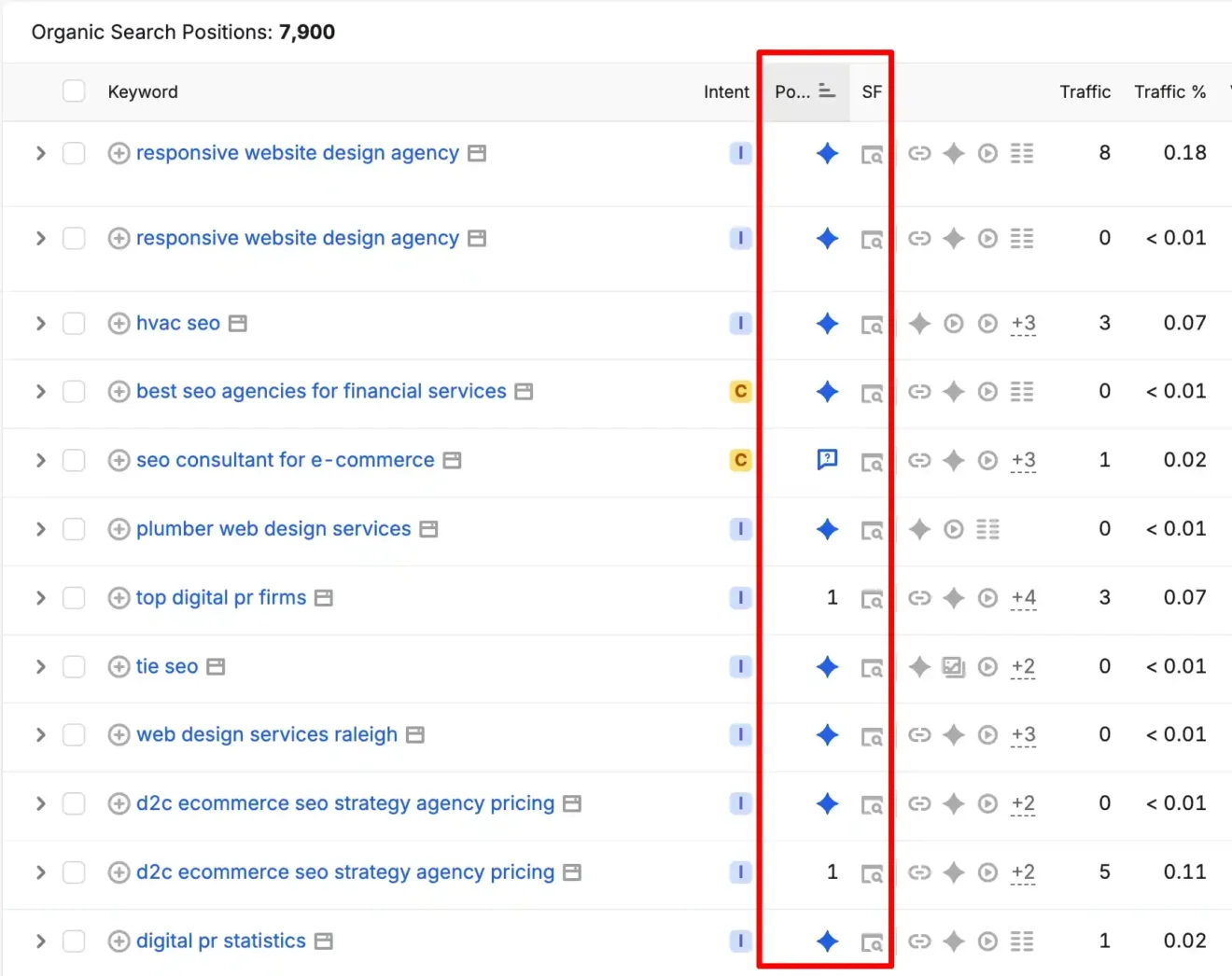
There are already tons of tools trying to “measure” AI visibility, from crazy expensive platforms to small indie products. I test a lot of them, and maybe we’ll talk about it in our next guide.
Nothing is 100% accurate right now. I honestly think we’re in the “pre-dashboard” phase.
As I already said in my “Top SEO Trends” topic, I’m pretty sure that in the near future, the big players like Google and OpenAI will roll out proper reporting where we can finally see AI search metrics in real time instead of reverse-engineering them like we do today.
Prompts I Use to Stress-Test AI Visibility
When your site starts gaining visibility in AI answers, you feel it. Leads mention it on calls, friends send you screenshots, and you catch your brand popping up in places where you never ranked before.
But feelings aside, I like to stress-test it in a very simple, very manual way: I sit down, open ChatGPT, Gemini, Perplexity (and other LLMs if necessary), and start typing the exact prompts my ideal customers would use.
Stuff like:
“best B2B SEO audit agency”
“best SaaS SEO agency for B2B startups”
“best SEO agency in LA, experienced in domain migrations”
I want my brand to appear in those shortlists. Not once, not by accident, but consistently. If you’re not in the list yet, that’s fine; this instantly gives you a clear target.
Instead of only seeking traffic to informational blogs and stats posts (which, to be fair, work really well in my experience), you start aiming for something bigger: being recommended when someone is ready to buy.
So when I talk about “winning” in AI search, I’m not just thinking about impressions or generic visibility. I’m thinking about those long prompts people use when they’re serious, and whether your brand is already in those lists or still completely invisible.
What Should You Track After an LLM SEO Audit?
An audit on its own does nothing. Classic SEO audit, AI SEO audit, LLM SEO audit; if it ends as a pretty PDF in someone’s Google Drive, it’s useless. Sometimes I joke that the first metric I track is “How many tasks from this audit did my team deliver?” I’m half joking… but only half.
Once the LLM SEO audit is complete, I mainly track two things in parallel: execution and impact.
On the execution side, I want to see movement.
Sometimes this is as simple as a shared sheet where we tick off “fixed,” “rewritten,” “removed,” or “completed.” If this part is slow, nothing else is important.
Here is what you should do next:
What to Track After an LLM SEO Audit
A practical follow-up process for turning audit findings into better AI visibility, stronger brand mentions, and cleaner crawler access.
Fix AI Crawler Access Issues
Start by reviewing robots.txt, server rules, CDN settings, blocked resources, JavaScript rendering issues, and any pages AI crawlers may struggle to access.
AI crawl blockers removedTrack Brand Mentions in LLMs
Monitor how often ChatGPT, Perplexity, Gemini, Claude, and other AI tools mention your brand for your main service, product, and comparison queries.
Brand visibility trackedReview Citation Sources
Check which pages, articles, directories, forums, listicles, and third-party websites LLMs use when they mention your category or competitors.
Citation gaps identifiedImprove Entity & Brand Signals
Strengthen your About page, author profiles, case studies, schema, external mentions, social profiles, and third-party references so AI systems can understand who you are.
Brand context improvedBuild Content for AI-Style Queries
Create direct-answer content around comparisons, alternatives, pricing, best tools, use cases, FAQs, definitions, and industry-specific buyer questions.
LLM-friendly content addedMeasure Leads Beyond Rankings
Track assisted conversions, demo requests, branded search growth, referral traffic, direct traffic, and leads that mention AI tools during sales calls or forms.
AI visibility tied to pipeline#1 Mistake I See in “AI SEO Audits
There are a few patterns I keep seeing again and again. First things first: people AI SEO audits are something completely alien. They throw away everything they know from “classic” SEO and start inventing new rules.
However, in reality, in 80% of cases, the same fundamentals still win. To make things cleaner, please look at the chart below:
Search Rankings Are Only Half the Story Now
Keyword Review
Search volume, intent, difficulty
Entity gaps, prompt demand, buyer questions
Content Audit
Rankings, cannibalization, freshness
Answer quality, clarity, extractability
Page Structure
Titles, headings, internal links
Clear sections, direct answers, source-ready content
Technical Check
Crawlability, indexing, speed, schema
AI crawler access, renderability, structured context
Authority Review
Backlinks and referring domains
Mentions, citations, reviews, expert references
Brand Signals
Branded search and reputation
Entity consistency across the web
Off-Page Audit
Link quality and relevance
Third-party mentions and trusted source coverage
How Often Should I Repeat an LLM SEO Audit for My Site?
I don’t think you need to run a full LLM-focused audit every month. That’s overkill and honestly a waste of time. For most B2B brands, a big, deep audit once or twice a year is enough, as long as you’re actively implementing the recommendations in between.
What I do like to do more frequently is mini-checks: reviewing key pages every few months, checking new content for first-hand experience, and tracking how AI-related traffic or mentions change over time.
You should also re-open the audit if something big happens: a major redesign, a migration, a big Google change, or if you suddenly see strange shifts in impressions, CTR, or lead quality.
Is It Risky to Rely Too Much on AI Search for My Future Traffic?
Yes, if you rely on any single channel too much, you’re playing a dangerous game, and that includes AI search. I love getting leads that say, “We found you on ChatGPT,” but I’d never build a business where that’s the only channel. These platforms can change how they answer questions, whose sites they trust, or what they show, and they won’t ask your permission first.
The way I think about it is simple: AI search should be one strong pillar, not the entire building. You still need organic traffic from Google, branded search, direct visits, email, social, referrals, and word of mouth.
If AI search engines drive extra visibility and leads, amazing. But if they disappear tomorrow and your whole funnel collapses, that’s a strategy problem, not an algorithm problem.
Should I Rewrite All My Content for AI Search?
Of course, no, please don’t turn on “panic mode” and start rewriting your entire site just because AI search is getting louder. I’d rather see you fix and upgrade your most important pages first; the ones that bring leads, explain your product clearly, or cover your key topics.
Once those core pages are strong, you can slowly work through the rest. Some pieces will deserve a full rewrite, some just need a few honest examples or updated sections, and some are simply not worth keeping at all.
Written by
Ashot NanayanSEO Strategist
Ashot Nanayan is an SEO strategist and the founder of B2BSEO.io. He helps B2B companies build search systems that do more than rank pages. His approach connects Google visibility, AI search presence, content depth, authority, and buyer intent, so brands appear where serious decisions start.